



West Bend, Wi – It was September 2013 when the new state historical marker on N. Main Street was placed across from Regner Park highlighting the people and products that made the West Bend Aluminum Company.
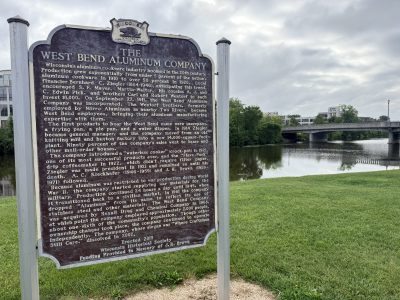
The six-foot marker, which pays tribute to men like Bernhardt C. Ziegler (1884-1946), S.F. Meyer, Martin Walter, A.J. and C. Edwin Pick, and Carl and Robert Wentorf, provides an extensive background on the local company that helped make the aluminum cookware industry boom in the 20th century.

Incorporated on September 27, 1911, the marker outlines the history of the West Bend Aluminum Company from its first products of a frying pan and water dipper to 1914 when “the company moved from an old knitting mill and button factory into a new 14,000-square-footplant.”
“Waterless cookers” and “Flavo-Perk” drip coffee makers were early successes of the 1920s along with corporate leaders like Ziegler, A.C. Kieckhafer and J.R. Brown.
Through World War II restrictions on aluminum forced the company to switch from kitchen cookware to “supplying war materials for the military.”

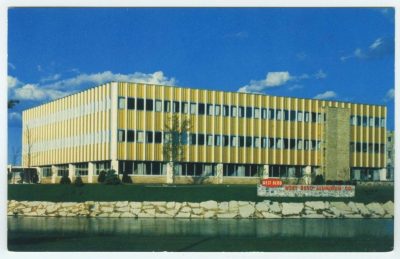
The final 40 years note the change in ownership and industry; in 1961 when the word “Aluminum” was dropped from the company name and in 1968 when “approximately 2,000 people, about one-sixth of the community’s population” were employed at the West Bend Company.
The final segment notes how the company slogan, “Where Craftsmen Still Care,” dissolved in 2002.
The marker, dedicated to the memory of J.R. Brown, was initiated and funded by Brown’s three daughters including Sally Brown Frahm, Dee Brestin, and Bonnie Rock, who now lives in Utah.
“My sisters and I felt there was nothing obvious left to remember the company that was important to West Bend,” said Rock.
“Our father put a lot of his time, energy, and skills into this company,” she said adding, “He always said “It’s just pots and pans.”
Rock, however, believed it was more. “The West Bend Aluminum Company involved many outstanding people and they made outstanding products sold worldwide.
“International competition has driven out much manufacturing in our country,” she said.
Rock profiled her father as a man who wanted to be a professor of history. “He was of college age during the depression and had a scholarship to the Naval Academy or Northwestern as an Austin Scholar in the Business School there.
“When he graduated as an Austin Scholar, he met and was hired by B.C. Ziegler as the assistant to the President of the West Bend Company. He was the only one of the seven Brown boys who did not see military action during WWII.
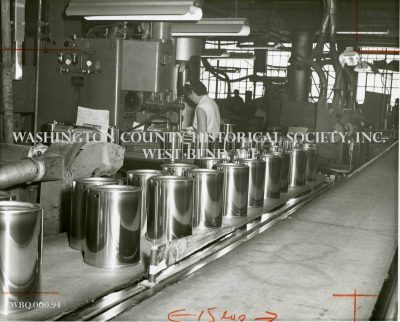
“He was told he was needed at the company where ammunition was being made,” said Rock.
Before B.C. Ziegler died, Rock said he asked her dad to become a mentor for his children and a help to his wife.
Eventually, Brown became President of the West Bend Company.
Daughter Dee Brestin, now living in Door County, said after her father’s death they found papers that he had been interviewed for months for the position at The West Bend Company.
“They looked into his family background and into the reputations of his six brothers, his parents, and his grandparents. They were looking for character,” said Brestin.
“Then they asked him to make a lifetime commitment, as they said he would eventually be president of the company. The men in leadership were men of integrity who cared about the employees and about the product they were making. We were amazed to read this and could not imagine it happening today,” she said.
Sally Brown Frahm said the sisters came up with the idea of a historical marker as a way to honor their father’s memory and the people who worked at the company.
“West Bend Aluminum contributed significantly to the history of West Bend,” said Frahm. “In 2006 I attended the 50th anniversary of my high school graduation and when friends took me to see the new condos I couldn’t believe there was no mention of the West Bend Aluminum Company anyplace.
“That prompted the desire for some sort of remembrance, a signpost to the past,” she said.
The sisters hope to gather in West Bend next summer or fall to officially dedicate the site of the marker.
There are currently more than 550 Wisconsin State Historical markers including five in Washington County. Can you name them?
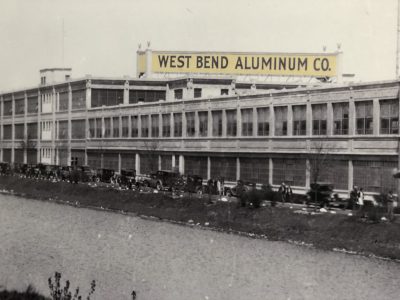
On a side note: The circa 1920 photo, courtesy the Washington County Historical Society, is of the West Bend Aluminum Company. In its heyday the company employed one sixth of the people living in the city of West Bend. Today, the two factories have been converted to condos and apartments that make up River Shores.
– There are currently more than 550 Wisconsin State Historical markers including five in Washington County. Can you name the five local markers?
– Can you identify this local treasure modeling West Bend pots and pans?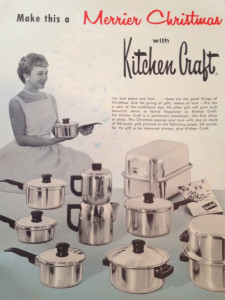

Thank you Judy for the WEST BEND ALUMINUM COMPANY article. We need reminders about the manufacturer who helped WEST BEND grow. We are grateful for their success.
Interesting article, renember the plant, traffic was something on Washington Avenue when 1st shift let out. Good memories.
I remember that alot of people who lived in West Bend worked there! My hometown was West Bend and there are many memories of the West Bend Company!