



March 30, 2026 – Slinger, Wi – Residents in the Village of Slinger are facing the possibility of a steep water rate increase, but village officials say the final structure is still in flux as they work with the Public Service Commission.
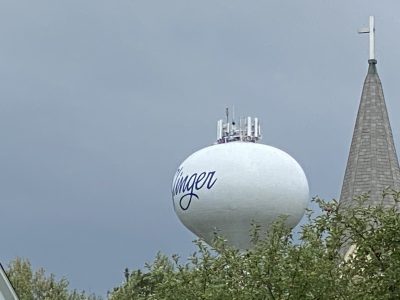
It was March 4, 2026, when more than 40 Slinger residents weighed in during a meeting with the Public Service Commission on a nearly 75% water rate increase.

Slinger Village Administrator Margaret Wilber confirmed the increase applies strictly to water rates and currently remains under review.
“We’re not certain of the amount,” Wilber said. “We have asked them (PSC) again to let us phase it in. We’re hoping to implement half and half over a two year increase. But we haven’t got a determination on that yet.”
The rate hike was never expected to reach the level now being discussed. Wilber said the village’s original study pointed to a significantly lower increase.
“Oh, gosh, no,” she said when asked if 75% was the original goal. “When we had the original study done about a year and a half ago, 52% was the amount they came back with… that was bad enough, but we felt we hadn’t increased it for quite a while, so we thought we’re going to have to live with that.”

After submitting the proposal to the Public Service Commission in July 2025, the numbers climbed.
“They came back after their review… 72%. And then by the time it hit the Zoom meeting, they said 75%,” Wilber said, noting the figures were determined by PSC staff, including administrator Eric Lindgren.
Now, village leaders are hoping to soften the impact by splitting the increase across two years, though that request still needs PSC approval.
“So still looking at a 75%, but over two years,” Wilber said. “Oh, 35% and 38%, whatever.”
She cautioned that nothing is finalized. “It has to be approved. I don’t want to get everyone’s hopes up.”

A decision could come within weeks, though the added request may extend the timeline. If approved on a standard schedule, residents could see changes as early as May, or possibly June.
“Usually it takes about a couple weeks… but now that we’ve asked them to reconsider the phasing of it, we’re expecting it might take a little longer, within a month or so,” Wilber said.

Wilber acknowledged the timing is difficult, especially as the village moves forward with other major capital projects, including a new police department and future library improvements.
The police department project, which has been in development since 2022, is estimated at about $14.6 million, while the village is also planning to borrow roughly $4 million for a new library in the coming years.
Despite the overlapping costs, Wilber said both projects have received strong community backing.
“We’ve gotten a lot of support in general for it,” she said. “I think most of the community understands that the police department has been in too small of an operation for years now. And there’s been a tremendous support for the library.”
Still, she admitted the stacking of costs alongside the water rate increase is not ideal.
“Yeah, I mean, that’s an unfortunate timing, definitely,” Wilber said. “But again, it was a matter of the board needing to, or trying to keep rates down for too long and not dealing with it at an earlier time when we probably should have.”

The increase is intended to stabilize the utility’s finances after years of relying on limited reserves.
“We’ve been operating on our cash balances for quite a while, but just barely,” she said. “So now we’ll be able to catch up with that and be able to afford some of the capital improvements that are needed.”
As for whether new development could help offset costs for existing residents, Wilber said developers already contribute to infrastructure but acknowledged a gap in one area.
“They do to some extent. They pay for the infrastructure that goes in,” she said.
However, the village does not currently charge a water impact fee.
“At this time, we don’t have a water impact fee, which I think is what you’re talking about. We do for sewer. We do for other utilities, but not for water at this time,” Wilber said.
Implementing such a fee is not currently under discussion and would require a formal process.
“That’s a whole process that has to go through statutory requirements,” she said.
For now, village officials remain focused on working with the Public Service Commission to determine whether the increase can be phased in—an approach they hope will make a difficult adjustment more manageable for residents.
Emails have been sent to every Village trustee. As of this article publication, none of the trustees have responded.
Below is contact information for village officials:
Margaret Wilber Administrator 262-644-2632
Scott Stortz – Village President – Village Board – 262-305-2301
Trustee:
Jake Bergum – jbergum@vi.slinger.wi.gov
Robert Neidinger – rneidinger@vi.slinger.wi.gov
Dean Otte – 262-623-1906 – dotte@vi.slinger.wi.gov
Lee Fredericks – 920-843-2007 – lfredericks@vi.slinger.wi.gov
March 5, 2026 – Slinger, WI – More than 40 Slinger residents logged in Wednesday morning to weigh in on a proposed water rate increase that would raise overall revenues by about 60%, with many residential customers seeing increases closer to 75%.
According to the notice on the Village website: The increase is necessary due to a 104.10 percent increase in gross plant investment and a 61.42 percent increase in operating expenses since the last water rate case was completed in 2010. The total increase in water revenues requested is $743,066 which will result in an estimated overall rate increase of 60.37 percent over the water utility’s present revenues.

Click HERE to watch the public hearing from
11 a.m. Wednesday, March 4, 2026
If the request is granted, the water bill for an average residential customer with a ⅝-inch or ¾-inch meter who uses 3,000 gallons of water per month will increase from $27.62 to $48.58, or 75.89 percent including the public fire protection charge.

Cassandra Buttke
Slinger State:Wi
To the Public Service Commission of Wisconsin,
I am a ratepayer served by Slinger Utilities and submit this comment in opposition to the proposed water rate increase.
The requested increase–60.37% in total revenues and approximately 75.89% for the average residential customer–is excessive and unreasonable. The magnitude of this increase is inconsistent with residents` ability to pay amid sustained increases in taxes, utilities, and cost of living. Approval would impose an undue and inequitable burden on ratepayers.
The current proposal materially exceeds what residents were notified of in August 2025 (53.91% effective January 2026). This escalation reflects shifting cost projections and undermines confidence that approving the present request will stabilize rates. It instead signals a high likelihood of continued rate pressure and repeat filings.
Service quality further fails to justify the proposed increase. Water hardness and quality issues impose ongoing, out-of-pocket costs on customers for mitigation systems (e.g., RO and whole-home treatment) and continued damage to appliances and fixtures. Ratepayers are already compensating for deficiencies in service quality; a rate increase of this magnitude without measurable quality improvements is unjustified.
The utility`s reliance on increased capital and O&M costs does not excuse inadequate financial planning. The Village and utility should demonstrate reserve building, aggressive pursuit of grants and alternative financing, and documented cost controls and reprioritization prior to shifting costs to ratepayers. If growth-related expansion drove capital needs, new development should bear a proportionate share of costs.
I request denial of the application as filed and conditioning any future approval on: (1) reconciliation of discrepancies between prior public notice and the current request; (2) documented long-term financial planning and reserves; (3) evidence of grants/alternative funding pursued; (4) demonstrated cost controls; (5) phased or materially smaller increases; and (6) measurable service quality improvements.
Respectfully,
Cassandra
Janis Braden
SLINGER, Wisconsin
I oppose the raising of our water bill for Slinger. at this time taxes went up. and everything I ng had gone up making it financially a burden to live in Slinger. jumping that high is ridiculous for any homeowner in Slinger area.
sincerely Janis Braden
Slinger resident
Laura Rathmann
Slinger, WI
Please make sure that your formal review of the “gross plant investments” and the “operating expenses” are of the conservative nature. Not nice to have, but must-haves. This is a VERY large increase, at a convenient time, given the current political climate. I do want the Slinger Utilities to function with high quality standards, as well as high ethic standards. If these are must-haves, I will gladly pay the appropriate increase. Thank you for ensuring fair customer pricing.
Laura Rathmann
Slinger Resident
Lisa Moker
Slinger, Wisconsin
In August 2025 we were informed via water bill message, the water rate increase of 53.91%. Now the increase request is 60.37%. Why the increase change???? This is a large increase all at once. Please consider the rate payers. Thank you.
Lisa Paulson
Slinger, WI
I do not think residents weren’t notified appropriately. A postcard in the mail or an email in addition to the notification on the water bill would have reached more people who have their accounts set to autopay or use paperless statements.
It is not the responsibility of residents to demand the company reassess the company’s needs. These rates have not been adjusted in 15 years and now residents will shoulder the burden of 15 years of increases in one go. My paycheck certainly did not increase 60% and it is unjust that we are penalized at a high cost for 15yrs of the water utility’s poor planning. As utilities are a monopoly I have no way to exercise the power of the purse to make another choice.
Will the water quality improve? Both times we have lived within village limits not only are we paying for water, but we are putting forth additional money for water filters because the drinking water does not taste good. It may be safe to drink, but why does it have such a strong taste? My well water did not have that taste. Water from other cities does not have that taste. My kids refuse to drink the water at school because it “tastes gross.” Will this 60% increase result in better tasting water so I can stop purchasing water filters for tap water?
In short, better notifying residents would have increased comments. I think a large percentage of residents will find a 60% increase due to the company’s 15years of poor planning or reassessment an extreme oversight, the residents should not have to fully shoulder this burden with such an extreme increase, and I sure do not want to pay 60% more for water without a noticeable increase in drinking quality.
- Web Comment. File a comment on the internet. Go to the Commission’s web site at http://psc.wi.gov, click the dropdown menu labeled “Commission Action”. Select the item labeled “File a Public Comment”. On the next page select the “File a comment” link that appears for docket number 5510-WR-104. Web comments shall be received no later than Friday, March 6, 2026.
- Mail Comment. Send a comment by U.S. Mail. All comments submitted by U.S. Mail shall be received no later than Friday, March 6, 2026 and shall be addressed to: Attn: Docket 5510-WR-104 Comments, Public Service Commission, P.O. Box 7854, Madison, WI 53707-7854.
- Mail Comment. Send a comment by U.S. Mail. All comments submitted by U.S. Mail shall be received no later than Friday, March 6, 2026 and shall be addressed to: Attn: Docket 5510-WR-104 Comments, Public Service Commission, P.O. Box 7854, Madison, WI 53707-7854.
- To access the documents, schedule, and other information about this docket, go to the Commission’s web site at http://psc.wi.gov, select the dropdown menu labeled ‘eServices”. Select the item labeled “Docket Search (CMS)”. On the next page enter 5510-WR-104 in the spaces labeled “Case #” and select “Search”.
If you have any questions, please contact Slinger Utilities at (262) 644-5265.
Margaret Wilber Administrator 262-644-2632
Scott Stortz – Village President – Village Board – 262-305-2301
Trustee:
Jake Bergum – jbergum@vi.slinger.wi.gov
Robert Neidinger – rneidinger@vi.slinger.wi.gov
Dean Otte – 262-623-1906 – dotte@vi.slinger.wi.gov
Lee Fredericks – 920-843-2007 – lfredericks@vi.slinger.wi.gov