



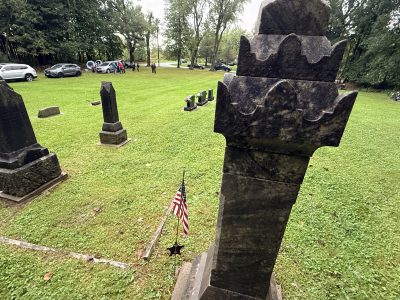
Kewskum, Wi – Rain fell steadily Friday morning at Buffalo Trinity Cemetery just north of Kewaskum, but it did little to dampen the turnout for a ceremony honoring two Washington County men who served during the Civil War. August Moldenhower and William Wilkins, both buried at Buffalo Trinity Cemetery along Kettle Moraine Drive, were remembered with the dedication of a new Civil War veterans monument.
The monument is part of a long-running Washington County project to identify and honor every Civil War veteran buried in the county.
Anne Trautner of the Kewaskum Historical Society opened the ceremony by providing the history of the cemetery, which dates to May 1, 1858, when the Evangelical Lutheran Trinity Church was organized as part of the Lutheran Buffalo Synod.

“That same year, August and Carolina Clue sold this plot of land to trustees of the new church,” Trautner said.
The first known burial in the cemetery was Henry Clug, born Nov. 7, 1803, and who died Sept. 17, 1860.
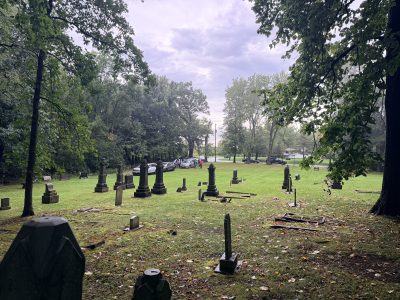
The cemetery is the last remaining reminder of what was once a small church community. A church once stood on the property, facing north, and a concrete block marking the location of its front step can still be seen.
“A carriage house for horses was located directly behind the church,” Trautner said. “And you can still see the stones from the foundation where the carriage house was.”
A school once stood on the northwest corner of the property, while the church parsonage was located across East Moraine Drive.
Trautner said the school and parsonage appear on an 1873 plat map, while an 1892 plat map identifies the German Lutheran church and cemetery.

The church was officially known as the Evangelical Lutheran Church, although it was also called Trinity Lutheran Church and Buffalo Trinity Church. Locally, however, it became known as the Moldenhower Church.
That name was likely connected to the Moldenhower family, which had deep roots in the area.
On March 25, 1876, much of the land surrounding the church was sold to Martin Moldenhower, son of August Moldenhower, one of the two veterans being honored.
Another of August Moldenhower’s sons, the Rev. Samuel Moldenhower, became pastor of the church around 1873.
“Prior to Samuel being named pastor, the church was served by visiting ministers,” Trautner said.
Samuel Moldenhower was born in the small German hamlet of Herkine in the Town of Jackson in 1848. He married Hannah Paddock on Feb. 17, 1874, and the couple had one daughter, Anna, nicknamed Annie.
Annie served as the church organist for many years.
Samuel remained pastor until 1906, when he resigned because of poor health. He and his wife moved to Milwaukee, where Annie was living with her husband.
Several other pastors served the congregation over the next three years before the parsonage was sold in October 1909.
Sometime between 1929 and 1937, the church itself was torn down.
“The church was torn down and buried right here beneath the ground where it once stood,” Trautner said.
The old parsonage across the road also disappeared. When the house that now stands there was constructed, workers uncovered walls from the former parsonage.
After the church disbanded, some members joined St. John Lutheran Church in Newburg while others attended St. Lucas Lutheran Church in Kewaskum. The church records were transferred to St. Lucas but have since been lost.
“Today, all that remains is the cemetery,” Trautner said.
On Nov. 16, 1977, the Town of Kewaskum acquired the cemetery. Since then, the town has cleaned and repaired some of the headstones, installed a new cemetery sign and continued to maintain the historic property.

Richard Lindbeck, a Vietnam veteran and longtime member of the Civil War memorial committee, then turned attention to the two men whose service brought everyone together on the rainy morning.
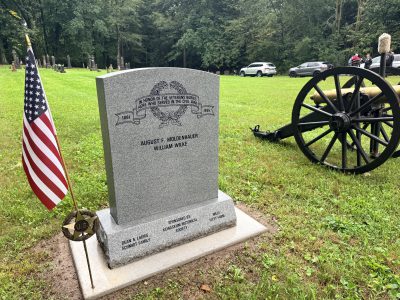
“Today, we’re here to recognize and honor our comrades who served in the Civil War,” Lindbeck said. “I’m Richard Lindbeck. I’ve been on the Civil War committee for 15 years plus, I think, maybe longer. I’m a Vietnam vet. I served in the United States Air Force for four years.”
Lindbeck said the project is about making sure the men who served during one of the most important periods in American history are not forgotten.
“This has been an ongoing project to ensure that we do not forget those who served during the Civil War,” he said. “The Civil War was a significant time in our nation’s history.”
Washington County has a particularly rich Civil War history, Lindbeck said, with more than 30 monuments now erected throughout the county.
The project was started by Jean Wendelborn, a World War II Navy veteran and research volunteer with the Washington County Historical Society. Wendelborn researched cemetery and church records, newspapers and information from the county Veterans Service Office in an effort to identify Civil War veterans buried throughout the county.
Wendelborn died before the research was completed, and the county Veterans Service Office took over the project. A volunteer committee was then formed to continue the work.
“People don’t realize there are 69 cemeteries in Washington County,” Lindbeck said. “We have identified every Civil War veteran from Washington County in those 69 cemeteries.”
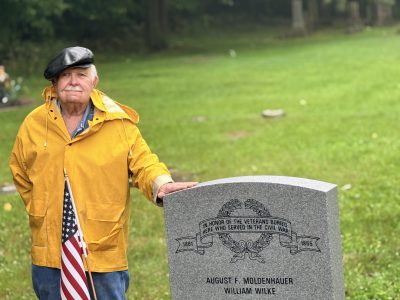
The monuments are funded entirely through donations.
“The monuments are paid for by donations from local businesses, community organizations, as well as individual donations,” Lindbeck said. “No tax dollars are used and the committee members donate our time.”
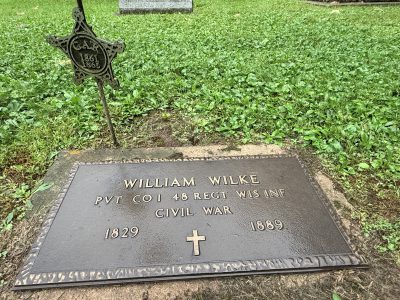
Wilkins was born Nov. 8, 1829, in Pomerania, Prussia, now part of Germany. Washington County naturalization records indicate he became a U.S. citizen March 31, 1858.
The 1870 and 1880 census records show Wilkins living with his wife, Caroline, in the area.

According to Civil War records compiled by local historians, Wilkins entered military service Aug. 21, 1862, with Company H of the 27th Wisconsin Infantry Regiment.
During his service, he participated in battles and campaigns in Arkansas, including Little Rock, Champagnolle Ferry, Jenkins’ Ferry, Pine Bluff and Spanish Fort.
He mustered out Aug. 29, 1865, and returned to the Kewaskum area, where he became a well-known farmer.
Wilkins died in a tragic accident Feb. 6, 1889.
According to an account published in the Kewaskum Statesman, Wilkins was returning home from the village with a load of lumber when his wagon overturned while traveling down a slope. He was thrown from the wagon and the lumber landed on him.
His head and chest were badly crushed.
Wilkins was 60 years old and left behind his wife and three children. The newspaper described him as well-liked by many friends who mourned his death.
August Moldenhower was born Sept. 18, 1818, in Pomerania, Prussia.
Washington County naturalization records show he became a U.S. citizen March 1, 1847. Census records place Moldenhower and his family in the Jackson area before later records showed him living in Kewaskum.
Tracing his military service proved more difficult, Lindbeck said.
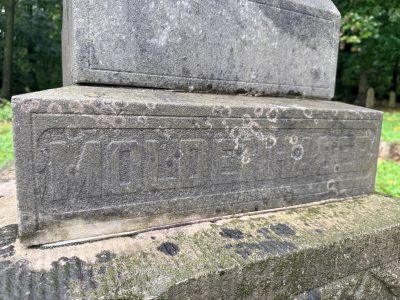
Civil War records indicate Moldenhower served during the war, while additional records identify him with the 26th Wisconsin Infantry, known as the German Regiment.
He enlisted Aug. 21, 1862, and was wounded at the Battle of Chancellorsville in Virginia on May 2, 1863.
He was discharged because of disability Oct. 5, 1863.
Moldenhower died Jan. 22, 1892, at the age of 72 and was buried at Buffalo Trinity Cemetery.
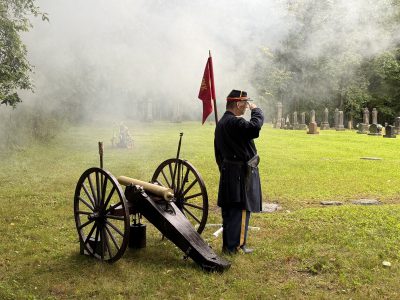
The ceremony concluded with an honor guard and the firing of a Civil War-era cannon, providing a final salute to the two men and to the generations of veterans who followed them.
Lindbeck said the purpose of the project extends beyond placing monuments in cemeteries.
“Today we want to recognize all the Civil War veterans preserved from Washington County,” he said.