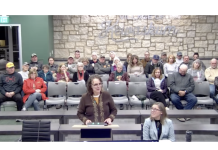
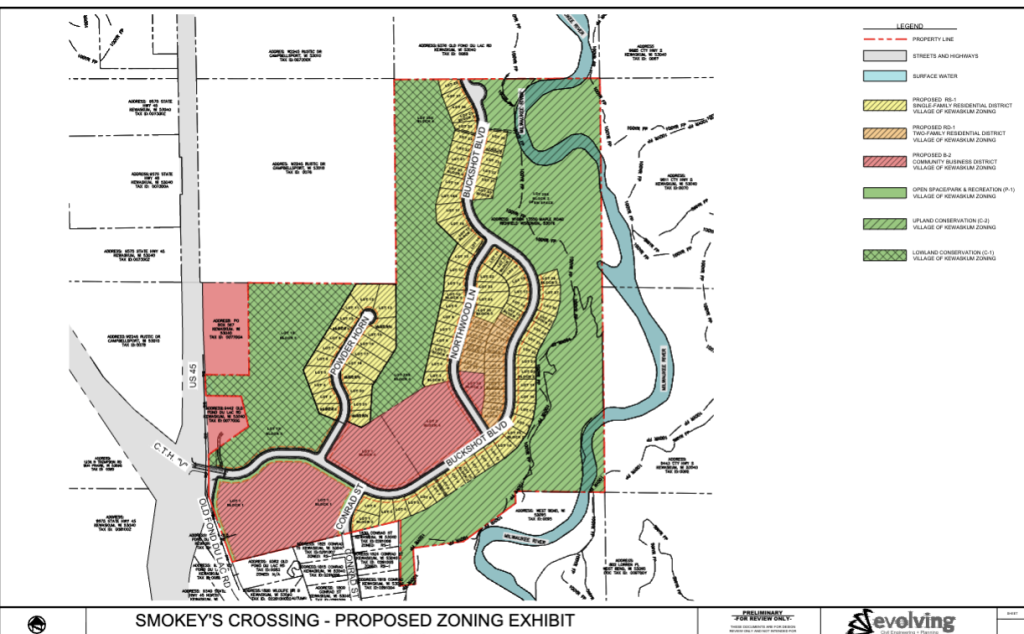
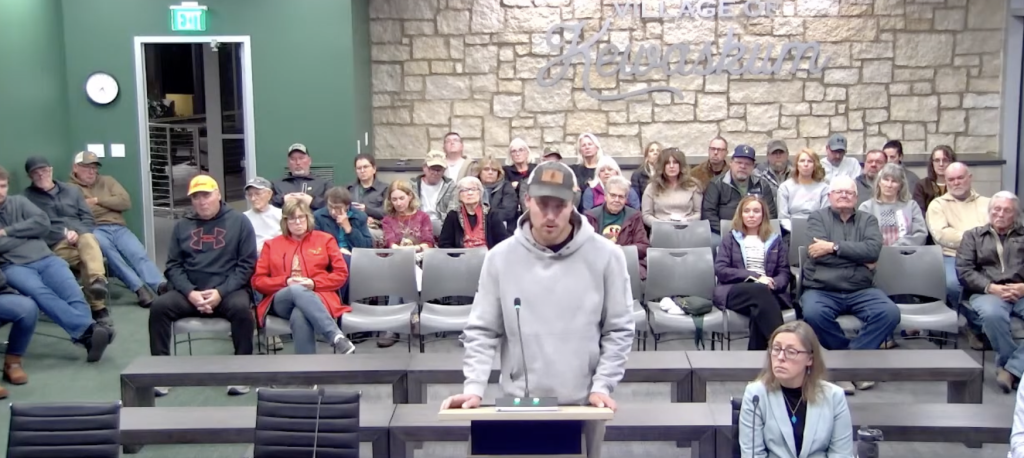
November 26, 2026 – Kewaskum, Wi – The Village of Kewaskum board held a joint meeting with the Plan Commission on Tuesday evening, November 24, 2026. About 50 people turned out as the hot topic was again TID 6 and the proposed Buckshot development. The property is on the northeast end of the Village, in the area of CTH V and Conrad Street. It is currently owned by Diana Stephan and Kathleen Weinand. Developers have been discussing for about two years turning the farmland into the future site for housing, a hotel, and possibly a sports complex.
After nearly two hours and a lot of questions, the Village Plan Commission followed by the Village Board moved to table this discussion and refer it to a public hearing at a later date.
After the meeting, Plan Commission member Derek Peterson raised concerns about the proposed changes to the village’s comprehensive plan, saying the amendments could alter the community’s long-term vision without adequate public discussion. Peterson drafted a letter to the village administrator and village president expressing his concerns.
Peterson, who previously served on the Kewaskum Village Board during the early to mid-2000s, said he was involved in the planning discussions that helped shape the original 2035 comprehensive plan. Those discussions included joint meetings between village and town officials and public visioning sessions.
He said the proposed amendments on Tuesday brought back concerns about changing a plan that had been developed through considerable time and public participation.
“I’m not opposed to development or growth, obviously, but you need to preserve the integrity of the whole comprehensive planning process because a lot of time and effort went into it, along with public participation, which did establish that long-term vision,” Peterson said.
“I don’t think you can have significant changes to that vision just by having one meeting. Otherwise, it almost makes the whole point of planning sort of like a moot process.”
Peterson said one of his biggest concerns is that changes being considered to accommodate a particular development could remain in the comprehensive plan even if that development never happens.
“If this development never materializes, these changes do become part of the comprehensive plan and will remain in place,” he said. “And then 10 years from now, when the circumstances surrounding all these amendments may be long forgotten, the revised standards we adopt on this one night could be used to justify entirely different developments elsewhere in the village.”
Peterson also questioned the explanation that the amendments were needed to bring the village into compliance with development standards, particularly regarding mixed-use planning.
Following the meeting, Peterson submitted a request for clarification to the village, questioning whether state law actually requires the village to establish mixed-use districts or whether the statute gives communities discretion.
“I believe it’s important to distinguish between correcting an existing deficiency and making discretionary changes to the village’s long-term planning mission,” he wrote in his request for clarification.
Peterson said the distinction matters because the comprehensive plan is where residents have an opportunity to help establish the community’s direction.
“If anybody can come in and just say, ‘Hey, you know, I want you to consider this,’ and then we’re like, ‘Oh, well, to consider it, we have to go change the plan first,’ that’s not really community-driven development,” he said. “That’s developer-driven development. Or developer vision, not community vision.”
He also pointed to proposed changes involving density, saying the potential increases were significant and deserved more attention than they received during the discussion.
“You’re increasing densities like 93% in some areas. This is significant,” Peterson said.
Peterson noted the same long-term vision was carried forward from the 2035 comprehensive plan into the village’s 2050 update, which was completed around 2019.
“I just want to make sure that everybody’s on the same page as far as this is actually a change to the vision that the village did establish,” he said.
For Peterson, the concern is not whether Kewaskum should grow, but whether changes to the community’s established planning vision are being fully understood before they are adopted.
Below is transcription from the Tuesday night meeting:
Administrator Hiller – The request came from the landowner’s, Diana Stephan and Kathleen Weinand, who own seven parcels and have asked the village to take two actions.
First is to amend the future land use map, and in the comprehensive plan, and the second is to rezone the parcels from A1 Agriculture and RS1 to a mixture of RS1, RD1, B2, P1, C1, and C2.
Tonight’s actions in order are, first, the village ward holds the public hearing on the Plan Amendment. Second, the Plan Commission considers the resolution, which recommends the Plan Amendment. Three, the Plan Commission makes the recommendation on the zoning, and for, the village board considers the ordinance, which adopts the Plan Amendment.
The village board will not rezone the land tonight. The rezoning comes back to the board as a separate action, with its own required notice and public hearing.
Residents will have another formal chance to be heard. TID 6 is also a separate process. Creating a tax increment district has its own statutory steps, including a joint review board. It is not on tonight’s agenda, and, in fact, has already been finished. as well as the annexation has already been finished. So why the Planned Map has to be amended before the land can be rezoned? State law requires the zoning to match the plan.
Since January 1, 2010, any zoning, subdivision, or official mapping ordinance adopted, or amended, must be consistent with the community’s adopted comprehensive plan. That’s in state statute. Consistent has a legal definition. The action must either advance the plans, objectives, goals, and policies, or at least not contradict them. The current map does not support what the owners are proposing. It shows these parcels mainly as medium low, density residential, and primary environmental corridor. Hey, rezoning the business, two family, and higher density residential would conflict with the map.
The village cannot lawfully approve it as the plan stands. State law provides the fix. Amend the plan first. When a proposed action would conflict with the plan, the community must amend the plan. Following its adopted procedures rather than acting arbitrarily. That is why the Plan Amendment comes first tonight and the rezoning follows. So, amending the plan follows a set process. The village gives public notice at least 30 days ahead. The village holds at least one public hearing. The Plan Commission recommends the amendment by resolution. The village aboard adopts it by ordinance. The village sends the amended plan to neighboring governments and state agencies following approval. The village met each requirement so far. The notice was published on October 22, Draft copies were available starting October 23, and written comments were accepted. However, none were received.
A planned amendment is normal and expected. Comprehensive plans have to be reviewed at least every 10 years. And state law places no limit on how often they can be amended. The plan is a guide for growth, and it is meant to be updated as real proposals come forward. This is amendment number three to the 2050 plan.
Additionally, it’s important to know that the village does not own the land. This is private property. The village is not the buyer, or the seller, or the developer. The owners have the right to apply. Any property owner may ask the village to change the plan or the zoning, and the village is required to process that request fairly, and according to its adopted procedures.
The village cannot stop the owners from selling. A sale is between the owners and the buyer. The villages role is limited to how the land may be used. Through the plan, zoning, the subdivision review, and the site plan review. Denying the request would not freeze the land as open space or farmland. The owners would keep their current rights under A1 and RS1 zoning, and they could sell the land or come back with a different proposal. The board has to decide on the record. Its decision should rest on the adopted plan. The ordinance standards, and the evidence in the record. So, for this evening, the village’s job tonight is not to decide whether we like or dislike the particular developer. It is to follow the process the state law requires. Listen to every resident and make a decision grounded in our comprehensive plan and ordinances. And tonight is just one step in the process. It is not the last step.
On a side note:
– Neither of the property owners nor a representative/ attorney for them were in attendance at the meeting.
– Developer Billy Boyd was also not in attendance at the meeting.
Village Attorney Ian Prust explained that the proposed comprehensive plan amendment has two main parts: updating the language in the plan and changing the land-use categories for several parcels.
Here is a breakdown of what the changes mean.
Updates to the comprehensive plan
– Mixed-use development: Adds a category that allows a combination of residential and commercial uses. This could mean homes or apartments alongside businesses. The plan does not specify how much of each must be included.
– High-density residential: Increases the number of potential housing units from 21.8 to 42 per acre and reduces the minimum lot area per dwelling unit from 2,000 to 1,000 square feet. The goal is to allow more flexibility for smaller, potentially more affordable housing options.
– Medium-density residential: Updates the language to allow additional housing styles, including duplexes and twin homes. It also adjusts the minimum square footage requirements to allow for newer housing layouts.
– Commercial development: Makes minor wording changes to broaden the types of businesses allowed under the commercial category. Hotels are specifically added as a potential use.
– Parks and recreation: Adds more specific language identifying recreational uses that could be included in future development.
Changes to land-use designations
The second part of the amendment changes how several parcels are categorized in the village’s comprehensive plan.
Some properties currently designated for medium-low-density residential development would be changed to categories that include:
Medium-density residential.
Medium-high-density residential.
High-density residential.
Mixed-use development.
Commercial development.
Parks and recreational areas.
Environmental corridors and surface water.
The exact designation varies by parcel. The proposed changes are outlined individually in the resolution.
What does this actually mean?
Prust emphasized that the comprehensive plan is a broad guide for future development. It does not approve a specific development or determine exactly what will be built on each property.
He compared the development process to looking at a property in three stages:
Comprehensive plan: The big-picture vision for how an area could develop.
Zoning: The next level of detail, spelling out what types of development are allowed and under what conditions.
Site plan: The actual development proposal showing what will be built on the property.
In other words, changing the comprehensive plan does not mean a developer can immediately begin construction.
Additional zoning approvals and site-plan reviews would still be required.
Why change the plan?
Prust said comprehensive plan amendments are common when communities experience growth or when new development opportunities arise.
He noted:
Communities need to periodically update their plans to reflect changing development needs.
A comprehensive plan should allow for different types of housing to accommodate different income levels and demographics.
Communities cannot simply plan to exclude growth or limit housing options to large lots.
The plan should provide flexibility for a mix of residential, commercial and recreational uses.
The actual development will also depend on what a property owner or developer proposes and what the village approves.
The main takeaway
The proposed amendment, according to village officials is a broad change to how several properties could be developed in the future. It opens the door to more housing density, mixed-use development, commercial opportunities and recreational uses. It does not approve a specific building project or guarantee that any of those uses will actually happen. Those details would come through future zoning requests, development proposals and village approval processes.
Public speaking portion of meeting:
My name is Holly Knick. I’m actually part of the town board of Kewaskum and the Plan Commission and I guess when we got the notice, so thank you for sending that to us. Obviously, we were interested. I also work on our comp plan for the town, and this was something that I wanted to make sure we knew what you guys were thinking, and where it was going, ’cause eventually that does affect us and I know we’re not your primary goal. Your constituents are, and I understand that.
I agree with Ian. We need to make arrangements for all sorts of demographics, but we also have a very unique community, and part of our residents, they’ve reached out to us individually, which is why myself and a few of the board members are here, because we wanted to share with you that, although we support that, we really want to make sure that we’re all in the same alignment on our town and the uses we’re allowing in the area. I know you’ve got a big job. There’s lots of factors, right? There’s lots of things to consider.
I get that. I’ve seen them myself I just would ask that you would do your research, and make sure the things you’re allowing in the township are truly what’s going to be better for the township, or for the village, as well as the township, because, like I said, it eventually affects all of us. I know we’re not your primary concern and we want to make sure that the village, the town, we stay unique, and the things we offer, we have great programs, great environments, great kids. that we want to support, and their activities. So, thank you.
Anne Trautner – I am the Kewaskum Town Clerk, and I am speaking on behalf of the dozens of Kewaskum Town residents who have reached out to me. We are your neighbors, your friends and your co-workers. The decisions being made here today affect not only the village, but all town residents as well. The area you are considering rezoning is a residential area with a beautiful landscape and views, abundant with wildlife. It is not the right location for a sports complex, hotel and commercial development. It will add unwanted traffic, including on town roads. You are considering changing the landscape and the rural character that make Kewaskum a unique and desirable place to live.
Two years ago, I received paperwork that the land now known as Smokey’s Crossing was going to be annexed into the village. I called the state and asked if there was anything the town could do to prevent this, and they said No. They said this was undeveloped land, so the town had no recourse. I explained that this was agricultural land and was being farmed. But it turns out that means nothing to the state. The state does not care if agricultural land disappears from the entire countryside.
To make it even more frustrating, a town resident offered to purchase the land and farm it. He couldn’t be here tonight, but he asks if there is any way that can still happen. The only ones who can make that possible are village officials, as you decide zoning for this area. You are the ones who will decide what this area will offer future generations.
A comprehensive plan is a plan for the future. The village has a long history of planning to keep this a small community and preserving its rural character. That is why the current comprehensive plan has this area designated as a low-density residential area. We are asking that you keep this vision for the future. It is what other village leaders have done. Several decades ago, village leaders voted against creating a bypass around the village.
The people wanted to keep this a small community. Just a few years ago, the DOT proposed making Fond du Lac Avenue a four-lane road. The village board voted against it. The people wanted to keep this a small community. And most recently, the village board voted to allow ATVs in the village. The people wanted to keep this a small community.
So, making the proposed changes to this comprehensive plan is going against what the people want.
As village officials, you represent the people, and I beg you to listen to the people and to serve them well. Be brave and look at what is best for the community’s future. While I am not opposed to all development, this is not the right place for this proposal. It is OK to say no to it. It is the right thing to do.
Sandy Russ – I completely agree with what’s been said by both of the people who have preceded me. I feel like this was zoned for low density and agricultural. Now we’re taking an extreme opposite end of that and going from low density, not even to medium, but high, as well as multi family, multilevel, commercial, completely opposite of what it was originally zoned for. And I think that development is good. We need development, we need to increase our tax base.
I think everybody here understands that. I don’t think anybody is opposed to that. But what people are opposed to, what you’ve heard, other people saying, and what I’ve heard, and what I’ve seen you guys have seen in the surveys, is what is being proposed is not what is desired by your citizens of this community.
And, you guys keep saying nothing is set in stone or decided upon yet. But the same plan keeps being pushed forward. There has never been any changes or alternatives proposed by any of you. It’s as if everything we’re saying is falling on deaf ears. And it is not too late to do the right thing, like you were just asked to do.
We can’t sustain the traffic that’s going to come from some big commercial sports center and you have citizens who have lived in this community like myself for over 25 years. It would do a great disservice to the people who live right next to this development, much less the town people, and everybody else in town who has to absorb the traffic, the noise, but especially to those citizens that live next to it to put commercial buildings right next to their properties.
It would greatly devaluate it. It takes away from the small town charm of this community. There are other more feasible, better suited things that that land should be used for. If you wanted to have a sports complex or something to that effect, there are other, more suitable places within our town and village that I feel would be much more appropriate.
It’s a gorgeous rural area. It does have tons of wildlife. We can still increase our tax base. We can still develop, we can still grow with something that is on a much smaller scale, much more subtle, much more pleasing, and much more in favor of what everybody that I have ever heard from would be looking for from all of you to do for us. Thank you.
Jack Felton – I just wanted to provide more support for what Anne had to say. Yeah, I’m sure you all know I have a survey out there. So there’s 224 responses. Take that as you please.
What would you personally like to see on the land associated with Smoky’s Crossing? 88 people, 40%, single family residential homes, 107 people, 48%, said parks, trails, or public recreational spaces, 107 people, 48%, at agriculture land were preserved open space. 76 said, No development, all the other responses were under 15%.
What would you most like, future development in this area to accomplish 147 people or 60 something percent, said, preserve the community’s small town character. The next closest was 102 for 45%. Said preserve existing land uses are natural features. The next closest was 74 people with 33%, said, create public parks, green space, or walking trails. So, just to give you more than just one person’s opinion, so far, that’s over 100 people from a survey. that don’t want the big stuff.
They want just the small town Kewaskum feel. And it’s possible, we just have to put away what’s going on right now. Thank you. Thank you.
Work or the content on WashingtonCountyInsider.com cannot be downloaded, printed, or copied. The work or content on WashingtonCountyInsider.com prohibits the end user to download, print, or otherwise distribute copies.
Subscribe
FREE local news at Washington County Insider on YouTube