







July 15, 2026 – Dodge Co. Wi. – A rare success story is unfolding at Horicon Marsh as the number of nesting black-necked stilts continues to climb.
The Wisconsin Department of Natural Resources (DNR) and the U.S. Fish and Wildlife Service have been surveying the migratory shorebirds since 2019 after the species established a breeding population at Horicon Marsh National Wildlife Refuge and the Horicon Marsh State Wildlife Area.

The latest survey documented 81 nests, including 78 on the federal refuge, nearly doubling the previous high recorded during a 2022 survey when all of the nests were found on the refuge.
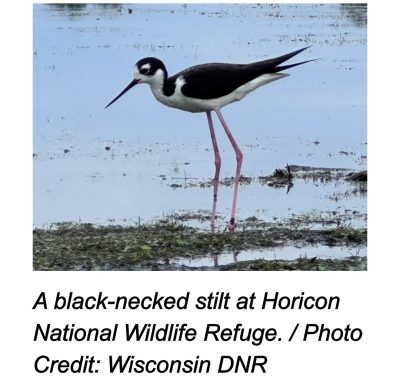
“Horicon Marsh, principally the refuge, likely now contains the largest breeding population of black-necked stilts anywhere east of the Mississippi not associated with coastal wetlands,” said Sumner Matteson, DNR avian ecologist. “This is a remarkable happening.”
Recognized by their striking black-and-white plumage and long, rose-colored legs, black-necked stilts are most commonly found along the southern, eastern and western coasts of the United States, with a handful of inland breeding locations in the West.
Over the past two decades, however, the birds have expanded into parts of the Upper Midwest. Horicon Marsh has proven to be an ideal nesting location, offering shallow mudflats and cattail habitat where the birds build their nests.
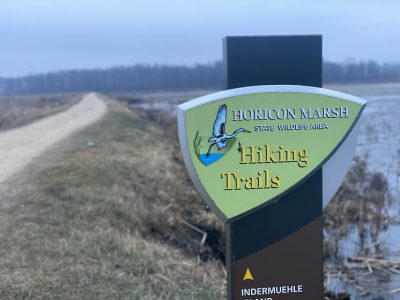
The first black-necked stilts nested at Horicon Marsh National Wildlife Refuge in 1999, marking Wisconsin’s first confirmed breeding record for the species.
Biologists say another reason for the growing population may be the birds’ breeding behavior. Black-necked stilts typically do not remain with the same mate from year to year. Instead, they often pair with new partners after each breeding season, a pattern that can help increase the number of breeding birds over time.
Horicon Marsh, recognized as a Wetland of International Importance and a Globally Important Bird Area, is jointly managed by the U.S. Fish and Wildlife Service and the Wisconsin DNR. The marsh is managed primarily to provide high-quality habitat for migratory waterfowl and other waterbirds, making it one of Wisconsin’s premier wildlife destinations.