




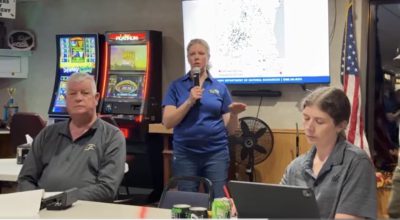
West Bend, Wi – Representatives from the DNR were recently in West Bend, Wi to answer questions about EHD, which is reportedly responsible for killing thousands of whitetail deer in southeast Wisconsin. There were about 130 local hunters and landowners in attendance.

According to the Wisconsin Department of Natural Resources, EHD (Epizootic Hemorrhagic Disease) in deer “is caused by a virus—specifically the epizootic hemorrhagic disease virus (EHDV) or closely related bluetongue virus (BTV)—which is spread through the bites of tiny insects called midges, biting gnats, or “no-see-ums”
Questions and DNR Answers
1. Are deer dying at a higher rate in Washington County than in surrounding areas?
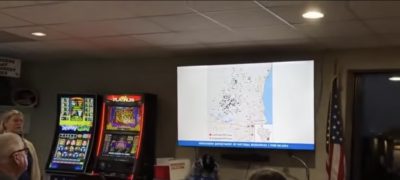
The attendee pointed to the map and said there appeared to be more reported deaths in the Washington County area, despite more dots appearing southwest of the county. The question was whether Washington County was experiencing higher mortality or whether the difference could be related to the deer population.
DNR response:
-
The map was described as a preliminary snapshot of the reports received.
-
DNR staff said the map was not a complete picture because of the volume of reports and the ongoing data cleanup.
-
The map only included reports with geographic coordinates.
-
Staff said the map could show general trends and areas being hit particularly hard, but it should not be used to determine exact mortality rates.
-
DNR staff also noted reports appearing along river corridors, including the Cedar Lake and Silver Lake areas.
2. Will there be restrictions on hunting in the areas most affected by EHD?
The attendee asked whether hunting restrictions would be put in place in the hardest-hit areas for bowhunting and the gun season.
DNR response:
-
DNR staff explained that changing the hunting season would require a formal process, including a scope statement submitted to the Natural Resources Board.
-
Staff said they did not know whether the available information had reached the point where changes were warranted.
-
Later in the discussion, the Southern District Wildlife Supervisor said the season could not simply be stopped immediately.
-
He explained that an emergency rule process would be required to address bonus permits, including identifying an emergency, preparing an emergency rule package, and obtaining the necessary approvals.
-
He said there was no immediate switch that would stop bonus permit sales while leaving previously purchased permits valid.
-
The process could involve Natural Resources Board consideration in November or December, depending on the steps and approvals required.
Click HERE for more insight from the DNR

3. How bad could the outbreak get before the first hard frost, and when will the deer population recover?
The attendee asked how large the outbreak could become before the first hard frost, whether the outbreak would affect doe reproduction, and when the deer population might recover in Washington County.
DNR response:
-
DNR staff said there was no evidence that EHD harms the reproductive health of adult deer.
-
Staff said it was unknown whether reports would continue at the same rate until the first hard frost.
-
An example from Ohio was provided. After a major outbreak, drone surveys conducted in late winter found deer numbers beginning to recover in heavily affected areas.
-
DNR staff said the Ohio example showed deer numbers returning to previous levels or close to them.
-
Staff did not provide a specific timeline for recovery in Washington County.
4. What is the tipping point for changing the hunting season or harvest quotas?
The attendee asked what the tipping point would be for taking action and how the DNR would determine whether enough deer remained to justify changes.
DNR response:
-
DNR staff said one of the key unknowns was what proportion of the total die-off was represented by the reported observations.
-
Staff said they did not know how many deer had been infected, how many had died, or what the total mortality figure would be.
-
The DNR said researchers were being asked to consider how that information could be determined.
-
Staff said decisions would have to be based on the data available.
-
The discussion included the importance of doe harvest in managing population growth.

5. Can the DNR stop selling bonus permits or prevent the additional doe tags from being issued?
An attendee asked whether the DNR could stop the sale of bonus permits and prevent additional doe tags from being given to hunters in Washington County.
DNR response:
-
DNR staff said the agency does not have an immediate switch to turn off bonus permit sales.
-
The process would require identifying an emergency, developing an emergency rule package, and obtaining Natural Resources Board approval.
-
Staff said the process would also involve public input, including input from hunters throughout the county.
-
The district supervisor said the hunting season itself could not simply be turned off immediately.
-
Staff explained that future season and harvest quota decisions could look different the following year.

6. Where can people take dead deer, particularly decomposing carcasses on private property?
Tom Nelson, who operates a wildlife removal company, asked what residents should do with decomposing deer on their property. He described challenges with removing carcasses from subdivisions and asked about the availability of dumpsters.
DNR response:
-
DNR staff explained that deer carcass waste dumpsters had historically been provided primarily to address CWD concerns.
-
EHD does not present the same carcass-transmission concern as CWD.
-
Staff said dumpsters could still be used for EHD deer, although moving a full carcass is more difficult than disposing of carcass waste from a harvested deer.
-
DNR staff said dumpsters would be available again in the fall but would not be placed until mid-October.
-
Staff noted that EHD does not pose a risk of transmission to humans through the carcass.
Important note: The discussion included concerns about disposing of rotting deer on private property. The response specifically addressed the purpose and timing of DNR dumpsters. It did not provide a complete, immediate disposal plan for every private property situation.
7. How many dead deer are going unreported?
An attendee asked how many deaths might be going unreported, noting some landowners may not walk their entire properties or discover deer carcasses before they begin to decompose.
DNR response:
-
The DNR acknowledged that the actual number of deaths was unknown.
-
Staff said they did not know the multiplier between reported observations and total mortality.
-
The DNR continued to encourage people to report recently dead deer to help track the outbreak.
-
An attendee offered an estimate that the actual number could be several times higher than the reported numbers, but this was not confirmed by the DNR.

8. How far could EHD spread before the first hard frost?
An attendee from the Richfield area asked how far the disease could spread before a hard frost slowed the spread, particularly because people in the area hunt in other parts of Wisconsin.
DNR response:
-
DNR staff said they continued to monitor the entire state.
-
Staff asked the public to report deer found dead in healthy body condition, particularly when found near water.
-
The DNR said it would continue collecting samples from areas where new cases were suspected.
-
Staff said a sample from the Manitowoc area had been submitted the previous week and had not detected EHD.
-
The DNR said it had not detected EHD in other parts of the state at that point but would continue monitoring.
What the DNR did not provide: A specific distance or geographic limit for how far the outbreak could spread before frost.
9. Why are some fawns being seen without their mothers?
Jeff, who said he was from Kewaskum and hunted south of Jackson Marsh, asked why some landowners were seeing fawns without their mothers. He wondered whether younger deer might have weaker immune systems and whether mature does were dying at a higher rate.
DNR response:
-
DNR staff said that surviving does exposed to EHD could develop antibodies and pass those antibodies to fawns born the following year.
-
Staff said this was not generally a factor in Wisconsin because most does do not already have those antibodies.
-
Regarding fawns appearing to survive more frequently than does in some areas, staff suggested it might relate to the biting midges’ preference for a larger body when seeking a blood meal.
-
Staff emphasized that EHD does not distinguish between deer types and that the disease affects bucks, does, and fawns.

10. How many deer are actually being lost compared with the number of reported cases?
Another attendee said he found two dead fawns and questioned whether the reported figures represented only a fraction of the actual die-off.
DNR response:
-
DNR staff said the number of reported observations could not be used to calculate the total mortality with certainty.
-
Staff had already explained that the DNR did not know the proportion of the die-off represented by the reports.
-
The DNR’s position was that additional reporting was necessary to better understand the outbreak’s extent and scale.
What the DNR said it does not know
Several questions did not receive a precise numerical answer. The DNR specifically acknowledged that it did not know:
-
The total number of deer that have died from EHD in Washington County.
-
What percentage of total mortality the reported observations represent.
-
How many deer are infected compared with the number that die.
-
Whether reports will continue at the same rate until the first hard frost.
-
The exact point at which changes to hunting seasons or quotas would be warranted.