




October 16, 2026 – West Bend, WI – Steve Burns grew up in West Bend, played baseball, attended West Bend East High School and built the kind of hometown memories that stay with you long after you leave. Now 42, Burns is taking the next step in his career with the Wisconsin Department of Natural Resources, where he will serve as the deer and elk specialist, bringing years of experience in wildlife biology, research and natural resource management to the position.
The new job is a promotion for Burns, who has spent nearly five years with the DNR as a wildlife biologist covering Brown, Door and Kewaunee counties. But his path to the position took him well beyond southeastern Wisconsin.
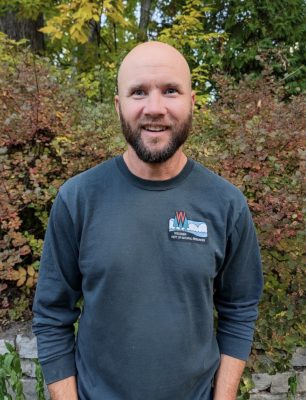
After graduating from West Bend East High School in 2002, Burns attended the University of Wisconsin-Stevens Point, where he studied wildlife ecology and management. He graduated in 2006 and began building a career that would take him to Iowa, Wyoming and central Wisconsin before bringing him back to the DNR.

His first stop after college was the Iowa Department of Natural Resources, where he worked as a Pheasants Forever technician. The job focused primarily on wildlife habitat work and species surveys.
From Iowa, Burns moved to the Wyoming Game and Fish Department, where he worked on chronic wasting disease research involving Rocky Mountain elk.
He later returned to Wisconsin to become zoo manager at Wildwood Park and Zoo in Marshfield, a position he held for 11 years.
Although managing a zoo was a departure from his earlier work with state natural resource agencies, the position fit his family’s needs at the time.
Eventually, an opportunity opened to return to natural resource management.
“It was just a good opportunity for me to kind of refocus my career path back to natural resources,” Burns said.
That opportunity brought him to the Wisconsin DNR and his wildlife biologist position in Green Bay.
In his new role, Burns will be working at the intersection of wildlife science, public policy and communication, particularly as Wisconsin addresses questions about deer populations, hunting regulations and wildlife health.
He said one of the things he has always enjoyed about natural resource work is the opportunity to connect scientific information with the people affected by management decisions.
“We do really good science at the DNR, and I wanted to be part of delivering that to people and also being a part of receiving feedback back from our customers and building that into the way we manage.”
It is a particularly important responsibility this year as southeastern Wisconsin deals with an outbreak of epizootic hemorrhagic disease, commonly known as EHD, which has killed significant numbers of deer.
Click HERE to read about the latest DNR EHD update
Burns said the full impact on the deer population will not be known until the DNR receives hunting harvest numbers from the current season and completes additional research.
Harvest data is one of the primary tools the agency uses to estimate deer populations. However, Burns cautioned that harvest numbers could decline for two reasons: fewer deer on the landscape and hunters choosing not to pursue deer in areas affected by the outbreak.
After the hunting seasons conclude, the DNR plans to explore additional research methods to better estimate how many deer remain in the affected areas.
Burns also acknowledged concerns raised by hunters and residents who questioned why the DNR did not change hunting season regulations in response to the outbreak.
He said the agency heard those concerns and held internal discussions, including conversations with agency leadership and elected officials, before deciding not to alter the hunting season format.
The DNR also considered how other states have responded to EHD outbreaks, including areas that have experienced more frequent outbreaks and higher mortality.
Burns said the agency expects deer populations to recover relatively quickly once the outbreak ends, based on experiences in neighboring states. Deer from surrounding areas can also move into available habitat.
He noted that southeastern Wisconsin entered the outbreak with high deer numbers and a dense population that annual harvest alone had struggled to manage.
Burns emphasized that this does not diminish the loss experienced by residents and hunters.
The challenge now is determining the extent of the impact and using that information to guide future management decisions.

While Burns’ new position will take him into some of Wisconsin’s most pressing wildlife management discussions, his roots remain in West Bend.
“I went to grade school at St. Frances Cabrini,” said Burns. “Mrs. Stokowski was our principal and I remember music was Mrs. Forston, her son Chris was my friend and I think we gave her more grief than she deserved.”
An avid baseball fan, Burns remembered his Little League teams were “playing for Hardees and Pardise Mobilemart.”
“We also biked to Regner Park and Toucan’s was a favorite hangout, that’s for sure,” he said.