


Town of Farmington, Wi – About a dozen people turned out this week for an informational meeting about a proposed roundabout at the intersection of County Highway H and State Highway 144.
The project is being considered by the Wisconsin Department of Transportation as a safety improvement for an intersection that has experienced serious crashes. Representatives from the DOT, including project manger Martin Villaca, explained that previous improvements, including changes to the intersection and resurfacing, have not eliminated the crash concerns.
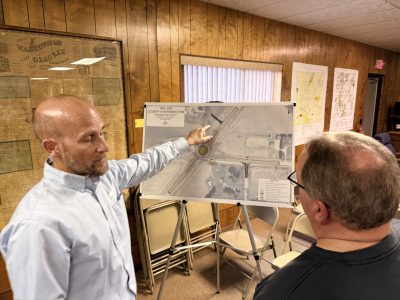
The proposed roundabout is designed to slow traffic and reduce the severity of crashes. But for residents and farmers who use the intersection every day, the questions go beyond safety.

Here are some of the questions raised at the meeting and the answers provided.
Why is a roundabout being proposed?
Answer: The intersection, according to the DOT, has a history of crashes, including high-severity crashes. Previous safety improvements have helped with sight distance and traffic movements, but crashes continue to occur.
The project is being considered through the Highway Safety Improvement Program, a federal funding program aimed at addressing crash patterns.
Officials said roundabouts have been shown to reduce the severity of crashes because vehicles must slow down and follow the circular roadway rather than traveling through the intersection at higher speeds.
“You still may have a crash on it,” one official explained, “but you’re not going to have the same severity.”
The basic idea is that a crash occurring at a much lower speed is less likely to result in serious injury or death.
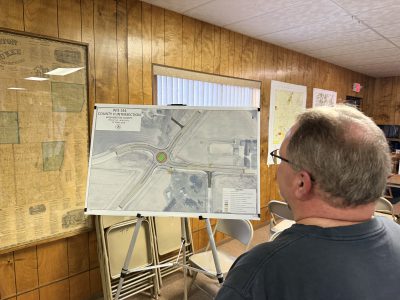
How much will the roundabout cost?
Answer: A final project cost was not provided at the meeting.
The project is still in the preliminary design and property acquisition stages. Officials said the cost will become clearer as the design is finalized, right-of-way needs are determined and utility relocation requirements are identified. In the past roundabouts came in around $1.8 million with confirmation by the DOT this project may be in the range of $2 million.
When will construction begin?
Answer: There is not yet a firm construction date.
Officials said there are several steps that must be completed before construction can begin. Those include environmental work, acquiring necessary real estate and coordinating with utilities.
Property owners need to be given a fair process for any land that is required for the project. Utilities also need a completed design so they know where facilities must be relocated.
The process takes time, even though officials acknowledged there is interest in moving the project forward because of the crash history.
Will the intersection be completely closed during construction?
Answer: Construction access and traffic control are still being worked out.
One concern raised at the meeting was whether a temporary access route could be provided during construction, particularly because the intersection is an important route for people living and working in the area and there were concerns about emergency vehicles that needed to get through.
Officials said construction staging and access will be addressed as the project moves forward.
What happens to the existing driveways?
Answer: Existing residential driveways are expected to remain.
Officials said the preliminary plans show some property acquisition, but the project is not simply eliminating every driveway in the area.
Some of the entrances shown on the plans are field entrances rather than residential driveways.
Will property owners have to give up land?
Answer: Some property acquisition is expected.
Officials described the current plans as preliminary. The amount of property needed is shown on the preliminary design, but the final right-of-way needs could change as the project develops.
There may also be temporary construction easements, meaning property could be used temporarily during construction rather than permanently acquired.
What about farmers who need to get large equipment through the roundabout?
Answer: The roundabout is being designed with farm equipment in mind.
This was one of the biggest concerns raised during the meeting, particularly for farmers moving large combines and other equipment during harvest.
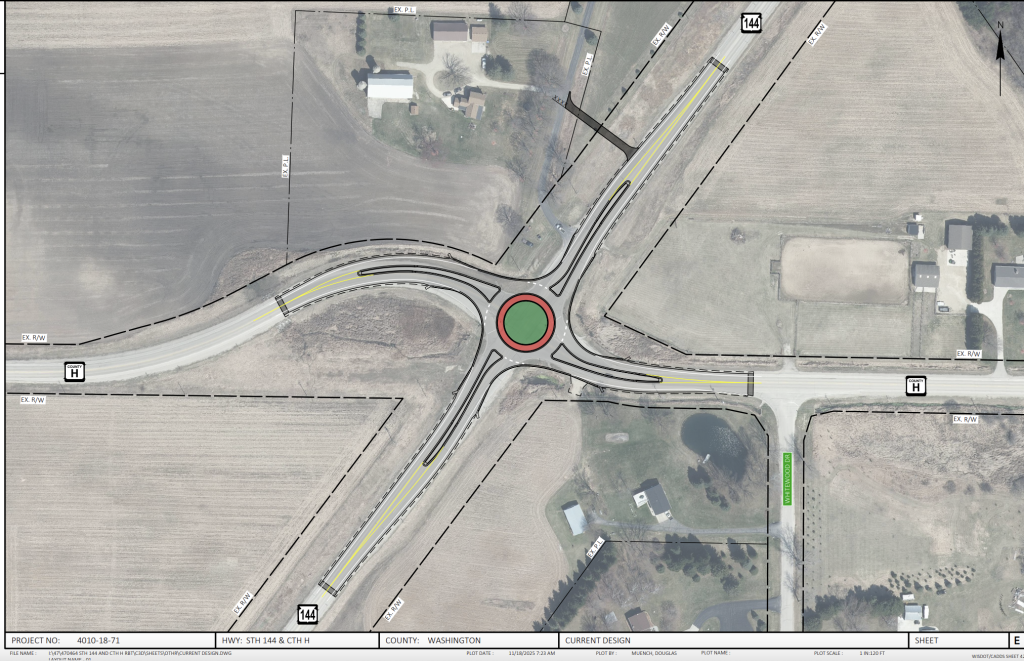
Officials said the design includes a truck apron around the center island. The apron is a paved area that large vehicles can use when they need additional room to maneuver.
A combine or other large piece of farm equipment would not necessarily follow the exact same path as a passenger vehicle. Larger equipment can use the additional paved area around the center island to make the turn.

For farming, what about a combine with a header attached?
Answer: Farmers will need to follow the requirements for transporting the equipment, including removing the header when required.
A question was specifically raised about a combine with a header that could be roughly 30 feet wide.
Officials indicated the roundabout has been designed to accommodate large agricultural equipment, but equipment that exceeds legal transportation dimensions still has to follow the applicable requirements.
The truck apron provides additional turning room for large vehicles.
Is the roundabout bigger because of farming equipment?
Answer: The roundabout is not being made larger simply because of farm equipment.
Instead, the design incorporates additional pavement around the center island to allow large vehicles to maneuver through the intersection.
Will cars have to get out of the way of a combine or other large truck?
Answer: Drivers need to yield appropriately and give large vehicles room to maneuver.
Officials noted that traffic laws require drivers to yield in the roundabout, and large trucks and farm equipment may need additional space to negotiate the intersection.
Why not simply leave the intersection as it is?
Answer: Officials said the crash history is the primary reason for considering a roundabout.
The intersection has been studied because of crashes, including serious crashes. Officials said some previous crashes involved vehicles traveling at higher speeds and making decisions while crossing or entering the intersection.
A roundabout changes the geometry of the intersection and forces traffic to slow down.
Will a roundabout eliminate crashes?
Answer: No.
Officials were clear that a roundabout does not eliminate crashes.
The goal is to reduce the number of severe crashes and lower the speeds at which crashes occur.
A vehicle entering a roundabout has to slow down to navigate the geometry of the intersection. That means a mistake that might previously have resulted in a high-speed collision could instead result in a lower-speed crash.
Why is safety such a concern at this intersection?
Answer: The intersection has experienced crashes significant enough to warrant additional safety improvements.
Officials said the Wisconsin Department of Transportation has reviewed the crash evidence and determined that the intersection remains a concern despite previous improvements.
The Highway Safety Improvement Program is specifically intended to address locations with crash patterns and improve safety.
Who is designing the roundabout?
Answer: The project team includes the Wisconsin Department of Transportation and a consulting firm with extensive experience designing roundabouts in Wisconsin.
Officials identified the consulting firm as Ayres Associates, which has worked on numerous roundabout projects in the state.
Why did the state recently resurface the roads if a roundabout was being considered?
Answer: Officials said the previous resurfacing project was separate from the proposed roundabout project.
The resurfacing project was completed while the roundabout was still in the planning process. Officials said the project team avoided spending money on new pavement in areas where the future roundabout would be constructed, while still providing usable pavement through the area.
What still has to happen before construction?
Answer: Several steps remain.
The project must move through the real estate acquisition process, environmental requirements and utility coordination.
Property owners whose land is affected must be contacted and provided a process for the acquisition of permanent right-of-way or temporary construction easements.
Utilities also need to know where facilities will have to be moved once the design is finalized.
When will residents know exactly what property is needed?
Answer: More details will become available as the preliminary design advances.
The lines shown at the meeting represent preliminary right-of-way needs. Officials stressed that the design is not yet final.
Property owners directly affected by the project will be part of the property acquisition process.
What is the biggest concern from farmers?
Answer: Maintaining access for large farm equipment.
For farmers, the intersection isn’t simply a place to drive through. It is part of the daily route between fields, farms and homes, particularly during planting and harvest.
Questions about combine width, headers and turning space underscored the importance of making sure agricultural equipment can move through the intersection without having to take an impractical detour.
Officials said the roundabout design accounts for large agricultural equipment through the use of the truck apron and additional maneuvering space.
What happens next?
Answer: The project will continue through design, property acquisition, environmental review and utility coordination before construction can begin.
The meeting gave residents an opportunity to ask questions early in the process, particularly about property, access and farming operations.
For the people who live and farm around CTH H and STH 144, the roundabout is more than a traffic project. It will change the way they enter and leave their properties and move farm equipment through an intersection they have used for years.
Officials said those concerns are part of the planning process as the design moves forward.

Town of Farmington – The Wisconsin Department of Transportation (WisDOT) will hold a public information meeting Tuesday, Oct. 6, 2026, regarding a proposed roundabout at the intersection of WIS 144 and County H in the Town of Farmington.
The meeting will run from 5 p.m. to 6:30 p.m. at the Farmington Town Hall, 9422 WIS 144, Kewaskum.
WisDOT is proposing to construct a roundabout at the intersection as a safety improvement. According to WisDOT, roundabouts can reduce delays and lessen the severity of crashes.
Click HERE for project details.
The project is currently scheduled for construction in 2028.
During construction, the WIS 144 and County H intersection will be closed, with a posted detour. WisDOT said detour routes are still being developed.
Residents and motorists attending the October 6 meeting will be able to view project exhibits and speak with WisDOT and project representatives. Project exhibits will be posted online following the meeting.
Motorists can check 511 Wisconsin for current traffic information.