






October 15, 2026 – Hartford, Wi – Neighbors in the City of Hartford, Wi voiced concerns this week during public comment at a Hartford common council meeting. The hot topic was about privacy, constitutional rights and the potential misuse of Flock Safety cameras, with several speakers asking the city to terminate its contract and remove the cameras. Those addressing the council said the cameras can record the movements of people who have not committed crimes, questioned who can access the information and warned that surveillance technology could be expanded or abused in the future.
Hartford Police Lt. Jim Zywicki acknowledged the importance of privacy and the need for safeguards, while disputing the characterization of Flock cameras as a system of constant surveillance. He also said the decision about whether the cameras remain in Hartford ultimately rests with the community.

Matthew Trewhella told the council he passes a Flock camera whenever he leaves his subdivision heading north.
“Every time I leave my house, morning and night, it doesn’t matter when,” Trewhella said. “That may not seem like a big deal to you guys, but I’m sure you wouldn’t feel great about a camera pointed right at your home.”
Trewhella said he was concerned about the government’s ability to monitor people’s movements on a large scale. He also raised questions about how surveillance technology could be used during a future emergency or government-imposed restriction.
“What would have happened if, during that same time in 2020, when this order was brought down to shut down people’s livelihoods, Governor Evers had a statewide surveillance system to look for and enforce his edicts and unjust laws and shut down our local communities and businesses?” he asked.
Trewhella said he believed the cameras could be used for purposes beyond reading license plates and urged the council to consider a public referendum.
“These cameras should be banned. They should be taken down as soon as possible,” he said.
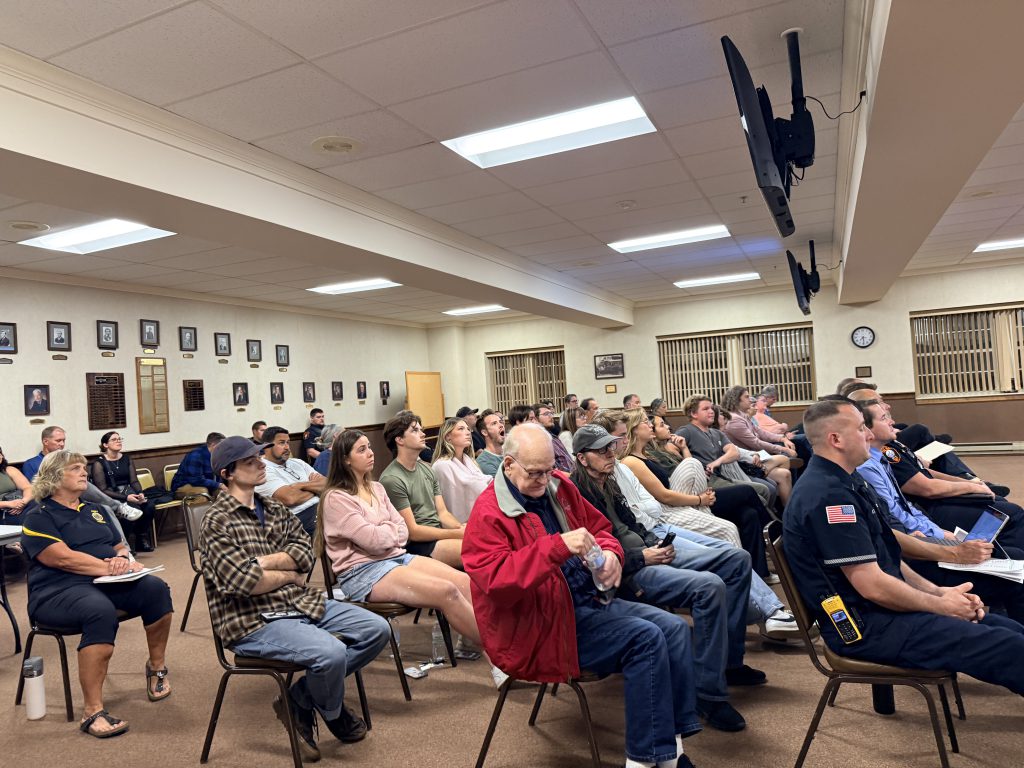
Another resident, Micah Harbrook, also asked the city to cancel its agreement with Flock Safety, arguing that ordinary residents should not have their vehicle movements recorded simply because they drive around town.
“Flock cameras can capture license plates and create records of vehicles traveling through our community,” Harbrook said. “That means ordinary people can have their vehicles recorded even when they’ve done nothing wrong.”
He questioned who can access the information, how long it is retained and what protections prevent misuse.
“I believe people should be able to drive around their community without having their movements unnecessarily documented and stored,” he said.
Harbrook emphasized his concerns were not directed at police officers or public safety. “It isn’t about being against the police. It’s not about being against technology, and it’s not about ignoring crime. It’s about believing there should be limits on surveillance,” he said.
He urged Hartford to remove its existing cameras rather than replace them with another company’s surveillance system.
“My concern isn’t just the company operating the cameras. It’s surveillance itself,” Harbrook said.

A resident identified in the transcript as Rosean, whose last name was unclear, said the city should end its Flock contract because of concerns about what the cameras collect and how the information could be used.
“I am here today to discuss Flock, with the ultimate goal of breaking the contract with Flock and ending the unconstitutional surveillance of our everyday lives,” Rosean said.
Rosean cited the Fourth Amendment and pointed to other Wisconsin communities that have ended, suspended or announced plans to end their use of Flock cameras.
“Surveillance cameras need to go, and I ask that the board seriously consider getting rid of them,” Rosean said.
David, another speaker, referenced the U.S. Supreme Court’s 2018 decision in Carpenter v. United States, which addressed government access to historical cellphone location records.
David argued that the ruling raised questions about the constitutionality of Flock cameras because they also create records that can be used to identify people’s movements.
“I understand this ruling concerns cellphone tracking. However, the same standard is applicable to Flock cameras, as they also create a record of your physical movements,” he said.
David asked the city to cover and remove the cameras, arguing that replacing them with another company’s automatic license plate readers would not resolve his concerns.
“Constitutional rights are not sacrificed for police convenience,” he said.
Another resident, Jeremiah, warned that surveillance systems could become more extensive over time.
“I’ll look at my kids, and I’ll have to honestly say, ‘The reason we’ve reached this point, children, is because good men said nothing when it was small,’” Jeremiah said.
He described the cameras as a seemingly small step that could lead to a larger system of government surveillance.
“We already have a track record of problems happening, and I only see it getting worse,” he said.
One speaker also described a 2024 incident involving a Hartford police officer and raised concerns about police practices and accountability.
The speaker said they had filed a police report after an officer allegedly shined a spotlight on and followed four vehicles, including theirs, to obtain license plate information. According to the speaker, the officer who responded said the conduct had been addressed and was inappropriate.
The resident also alleged the officer had described a department practice of targeting people with prior criminal weapons charges for traffic stops and questioning.
The speaker said residents should not have to choose between being followed by an officer and being pulled over.
“My response was that I would like to have neither,” the resident said.
The speaker called on the council to address concerns about police practices, transparency and public trust.
“Public safety matters, but so do civil liberties, transparency and trust in our city,” the resident said.
One woman who had a career background in law enforcement said she felt people have not heard all the good the cameras do.
“Say your child goes missing at a school, and you have a description. Maybe that car didn’t have a license plate, but it did have a bumper sticker. I can go into that camera system and search for a blue Ford with a bumper sticker on the right. Maybe that person doesn’t want to get pulled over by the police, so they might put the license plate back on their car. There are so many examples of how technology helps save lives. It helps locate missing people.”
The woman went on to outline how many cameras there were in all walks of life including in the schools and while people were shopping.
“You go into Walmart or TJ Maxx. I was in loss prevention 30 years ago when I got out of the Army. I could watch you when you came into Walmart. I could watch you when you came into TJ Maxx. Everything you did was recorded. I never asked where those recordings went after I recorded you. If I had a shoplifter and a case number, I gave that to the police. I didn’t know where that data went afterward. That was before I became a police officer.
“I feel like citizens have no idea how much they’re being tracked.
“I just want to say I think this is a great thing. I don’t want it taken away, and I’m a veteran. I fought for my country. I don’t feel like this interferes with my personal liberties. I think it’s going to save people’s lives. It’s going to help solve crimes.”
A disabled veteran who said he lived in the Hartford School District also challenged the restriction of public comment to city residents. He said he owned a home, paid taxes to the Hartford school system and drove in the city with his children.
“Are you denying me the constitutional rights I served to protect just because I don’t have a city address?” he asked.
Council members explained that the public-comment item was designated for city residents. The speaker continued to object to the restriction. “Respectfully, shame on you. Shame on you,” he said.
Zywicki said he understood why residents might view the technology as constant surveillance but argued that the description does not accurately explain how Flock cameras operate.
“Constant surveillance would in my mind dictate that we’re watching this car everywhere it’s driving constantly,” Zywicki said. “That’s not what the Flock cameras do. It’s an instant in time when that vehicle is in front of the camera that those plates are captured.”
He said the system does not allow an officer to simply log in and follow a vehicle’s movements continuously as it travels around the city.
Zywicki also acknowledged that new technology can outpace legislation and that additional laws may be needed to address concerns surrounding Flock and similar systems.
“I can tell you from the Hartford Police Department’s perspective, we have put as many guard rails as we can put into place because that is something important to us,” he said.
“Privacy rights are important. Citizens should be free or feel free in their movements and be free in their movements.”
Zywicki said the department has established policies intended to prevent officers from acting unethically or violating the terms of service governing the cameras. He added that proven misconduct can carry serious consequences, including loss of employment, loss of a pension and potential imprisonment.
He said safeguards and accountability are particularly important when using technology that can collect sensitive information.
“You can have the guidelines in place,” Zywicki said, noting that residents also raised concerns about the role of a third-party company.
Zywicki addressed concerns about Flock Safety’s access to information collected by the cameras, saying the city retains ownership of its data. “We control all of our discussions with Flock camera is that we own our data,” he said. “Flock does not own our data. That data is ours.”
Zywicki said he contacted the company again on Monday to review the information he had received and make sure his understanding was accurate.
He said Flock did not have the city’s permission to release its information and that the company could face consequences for releasing information belonging to the city.
His comments addressed the city’s data ownership and expectations of the company. They did not resolve every concern raised by residents about data access, retention, sharing or the possibility of misuse.
Asked directly whether the cameras would remain in Hartford, Zywicki said the decision ultimately belongs to the community.
“I think the citizens have to make, you know, there’s a thing in law enforcement, citizens get the police that they want in the communities,” he said.

“If the citizens don’t want to have the Flock cameras and that’s something that the citizens decide, then they go.”
Zywicki added that he believes residents may see value in the technology when they consider how it can assist police in solving difficult crimes.
“I think the citizens should be comforted knowing that we did put those guard rails in place to ensure that we’re being used ethically,” he said.
The public comments highlighted a fundamental question for Hartford: how to balance the potential investigative benefits of license plate reader technology with residents’ expectations of privacy and protections against government overreach.
Residents who spoke asked the city to end its agreement with Flock Safety and remove the cameras. Zywicki defended the department’s safeguards while acknowledging that the community should determine whether the technology remains in use.

Talia Trewhella led off the public speaking comments, “I’m here in total opposition to the Flock cameras surveilling our community.
“Right now, there are Flock cameras outside the two exits to my neighborhood. One is in Hartford and one is in Slinger. Every time my kids and I leave the house, there’s a camera pointing at us. I know I wasn’t alone in the eerie, dystopian feeling these cameras gave me.
“Why are these here? Who is behind them? Don’t we have some sort of privacy rights?
“That led me down the rabbit hole after looking deeper into it. I came to voice my concerns over Hartford’s lack of transparency regarding important questions about these surveillance cameras.
“I appreciate the chief of police and you guys having this debate, having this discussion and letting us hear some of the answers to those questions. But unfortunately, it left even more holes for us as citizens.
“Unfortunately, unlike many other agencies, the Hartford Police Department chose not to have a public transparency portal. We cannot see when other agencies put in a request to access our data.
“I know we were told up here today that 30 days is a retention limit, but other agencies don’t have the same retention limit. They can receive our data within that time frame and store it. Things like that make citizens a little weary. Red flags go up. It seems deceitful when we hear things like that.
“The same goes for the claim that Flock deletes our data. Flock actually anonymizes it and uses it to train its surveillance cameras, right?
“We heard today that they don’t use facial recognition. If any of you caught the U.S. Senate hearing, a chair from Arizona, one of the highest-crime cities in Arizona, got rid of all the Flock cameras because he called Flock on the phone and they lied to him.
“They said, “You can’t. Our cameras aren’t even clear enough to see faces.” He logged in from his house and he could see the faces.
“Just like you said earlier, council member, we may trust our local police, but we don’t trust this third-party billionaire company that also accesses our data and our children’s data.
“I filed a formal public records request with the city because some of this transparency was not easily accessible. I was told it would cost me $300 to obtain this information. With gas prices, I could not do that. Later, they provided me the same request for free. That’s something I wanted to address as well.
“Last month, the Wisconsin Institute for Law and Liberty filed a lawsuit against 11 Washington and Waukesha County municipalities over their unconstitutional use of cameras. They’re actively suing our neighbors, including Menomonee Falls, Brookfield, Hartland and Elm Grove, along with many others.
“The Wisconsin Institute for Law and Liberty also just last week filed a public records request to Hartford regarding our cameras.
“Innocent, law-abiding citizens are being surveilled and stored in a database. Access to our data, our whereabouts and our day-to-day activity is being tracked, although we were told today that it is not being sold.
“When a company buys a contract with Flock, like we were just told about Illinois, it receives access to thousands of other agencies. So it’s wordplay. They don’t sell our data, but if you buy a contract with Flock, you get access to 100,000 networks of cameras and their data. So our data is being sold.
“In light of Hartford’s lack of transparency, the sheer scale of this mass surveillance, the legal threats happening all around us and the community’s opposition, we’re asking you to defend our community, protect our rights and remove these cameras now, please.”