







Washington Co., WI – Farmers across Washington County, WI, can be seen making their way into the field to harvest corn. Gary Knuth from Hortonville, Wisconsin is proud of the old-fashioned way of doing it; he had his No. 7 John Deere corn sheller on display this past summer at the John Deere Green Reunion. Below is his story.
In the heart of the Midwest, in Hortonville, Wisconsin, Gary Knuth is doing more than collecting farm equipment—he’s preserving the legacy of American ingenuity in agriculture. One of his prized pieces? A vintage John Deere corn sheller, a machine that once revolutionized the way farmers processed corn and fed their livestock.

The process started after harvest, when ears of corn were dried in a corn crib. Once cured, farmers would load the cobs into the corn sheller, often using a drag elevator—a low and angled conveyer—to feed the ears into the machine.
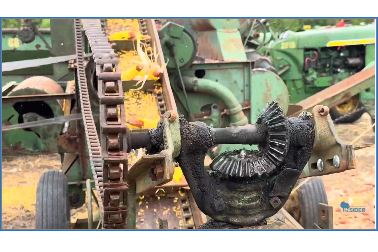
Inside the sheller, a spinning cylinder would knock the kernels off the cob. What followed was a symphony of mechanical motion: sieves to separate kernels from trash, fans to blow away husks and debris, and augers to move the clean grain where it needed to go—usually into a wagon.
The cob and trash were expelled through a separate elevator on the machine’s right side, leaving behind the golden product: shelled corn, easier for cattle to digest and more efficient to store and transport.
“This machine made farming a lot easier,” Knuth said. “Some guys even had these mounted on trucks, driving from farm to farm, helping neighbors shell their cribs.”
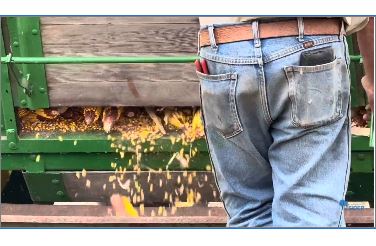
In rural America, where neighborliness is woven into the soil, a machine like this didn’t just process grain—it strengthened communities.
The John Deere sheller is a marvel of analog engineering. Knuth counts at least five belts at work: a main drive belt, plus several V-belts powering various components—the clean grain elevator, the trash blower, the reclaim auger.
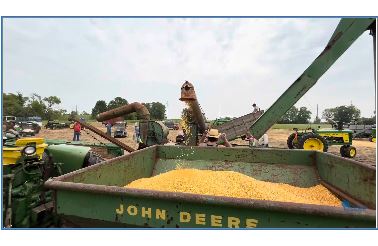
“Plenty of moving parts,” he said. “You like things moving, and people get a kick out of watching all those chains and pulleys.”
Despite the complexity, Knuth noted that maintenance isn’t always difficult. “Some parts you gotta tear the whole thing apart to get at it. But if you oil the chains, grease the fittings, and treat it right, you won’t be fixing it much.”

Near the machine’s tire sits a small blue can—belt dressing. “That’s so the main drive belt grips better,” Knuth said, applying it to the belt’s surface. “It’s not lubricated like oil. It just adds a little stickiness. Helps it bite the pulleys.”
Knuth’s love for John Deere started early—10 days old, to be exact, when he got his first toy tractor. His father farmed with Deere machines until 1960. Though the family left farming behind, Knuth never did.
“I helped whitewash barns in high school,” he said. “It just gets in your blood. I like to save these machines. Like this one here—and the flail chopper I’ve got at home—they’ve got a lot of life in them, and a lot of stories.”
Safety might look different today than it did back then. “Everyone knows a farmer missing a finger,” Knuth said. “You learn real quick not to put your hand where it don’t belong.”
He laughed and held up his hands. “Still got all 10, even after all these years.”
A key component of the sheller is the shoe—responsible for cleaning the corn. The label reads 202 strokes per minute.
“That’s the rhythm,” Knuth said. “It shakes the corn across a series of holes. The kernels fall through; trash goes over. The fan helps carry the lighter stuff out, and the clean corn ends up in the auger.”
And like most things on the farm, nothing goes to waste. “We grind up the old cobs and use ’em for chicken bedding. No sense in letting it rot.”

At John Deere Green show where Knuth proudly displayed his sheller, the machine was driven by his restored 1945 John Deere power unit—a stationary engine made for exactly this kind of task.
“Normally, these shows are all static,” Gary says. “Machines just sitting there. But I like to see things move. And I think people do too.”
For Knuth, the John Deere corn sheller is more than an antique—it’s a working memory of the Midwest’s agricultural backbone. It’s a story of progress, perseverance, and the hands-on innovation that fed a nation.
As belts turn and chains clatter, Knuth’s machine isn’t just shelling corn—it’s shelling stories, memories, and a time when neighbors helped neighbors, ingenuity ran on gears and grease, and a little common sense went a long way.

Great video, I’m looking for a Sheller just like that, it doesn’t have to be a John Deere, but a very similar Sheller. As Gary says in the video, people like watching all the belts chains and gears moving.
I show a collection of old stuff right near the Beach in Redondo Beach California, but I don’t have a Corn Sheller yet, so if anyone knows of one for sale I’d love to know about it.