






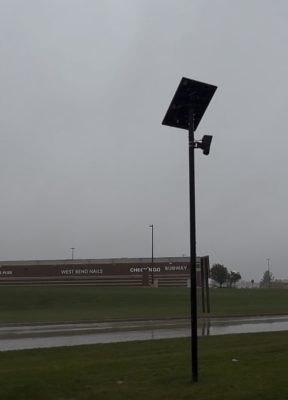
October 17, 2026 – Kewaskum, WI – On the heels of some heated public comments about Flock cameras during the Hartford common council meeting this week, comes word the Village of Kewaskum has ended its contract with Flock Safety, an organization that uses solar-powered cameras to capture images of vehicle license plates and some physical characteristics of a vehicle to reportedly help law enforcement.
Kewaskum Police Chief Tom Bishop said the village will not renew its contract with Flock Safety, citing unanswered questions about the future of license plate-reading technology and possible legislative action.

Bishop said Kewaskum had one Flock camera installed in 2023 under a three-year contract signed in late 2022. The camera was located along Highway 45, just north of Highway H, on the east side of the road. It was cut down and stolen in July 2026.
The contract expired in August, and the village did not renew it.
“I like the technology. It’s very good, very helpful for law enforcement,” Bishop said. “It’s good technology.”
However, Bishop said he was hesitant to enter another long-term agreement while questions remain about how the technology will be regulated.
“For us to commit to another long-term contract when there’s so much talk about this technology? Is the legislature going to pursue something?” Bishop said. “There’s just too many unknowns at the moment. It did not seem smart to enter into another long-term contract.”
Kewaskum paid approximately $2,000 per year for its single camera, according to Bishop.
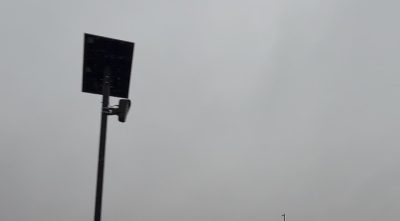
He said the stolen camera did not capture images of people near the equipment. It specifically photographed the rear of vehicles as they drove past. Because the camera was solar-powered, cutting its power connections would have shut it down, leaving no images of whoever took it.

Kewaskum’s decision comes as Flock cameras have become a topic of debate in Hartford, where residents recently asked the Common Council to remove the cameras.
Bishop said he does not foresee Kewaskum obtaining another Flock camera anytime soon.
“It’s good for law enforcement, but clearly there’s some larger societal questions to figure out at least before I jump back into another contract,” he said.
Click HERE to read about concerns from taxpayers in Hartford, WI
Washington County Sheriff Martin Schulteis said his office also uses Flock cameras, including cameras positioned around the county’s perimeter. The Sheriff’s Office also manages additional cameras for the Village of Richfield.
Schulteis said his office was the last public safety agency in Washington County, WI to adopt the technology because he had concerns about privacy and government surveillance.
“I do have some of those concerns, too, about Big Brother,” Schulteis said.
He said the technology can help investigators solve serious crimes, including armed home invasions and homicide cases, and bring closure to victims.
“What’s hard for me is, I was weighing the good that they do,” he said.
Schulteis said he supports establishing clearer rules governing the technology.
“I wouldn’t mind having some formal guardrails that would be enacted that would define the use of them,” he said. “I think that’s very reasonable.”

Schulteis said license plate data is retained for 30 days by the Sheriff’s Office and, according to his understanding, by Flock. He also said the company does not sell license plate data to third parties without permission from the agency that controls it.
He acknowledged the concerns raised in Hartford regarding how government policies could change in the future and whether technology introduced for one purpose might eventually be used for another.
Schulteis said he understands the potential for problems but also sees the investigative value of the cameras.
“It’s tough for me because I see all the good that can come from it,” he said, “but I also understand there’s that potential for issues.”
During Hartford’s common council meeting, a majority of residents spoke out against Flock cameras including Matthew and Talia Trewella who presented a petition with more than 150 signatures collected in 13 days opposing the cameras.
The couple questioned the cameras’ ability to track people’s movements without a warrant, arguing the issue involves constitutional rights and privacy, not simply convenience for law enforcement.
They also raised concerns about transparency after Matthew said he was quoted $300 to obtain information about the cameras from the city. Matthew said he met with the police chief, who he described as sharing concerns about privacy, and the couple emphasized they support local law enforcement but do not believe Flock cameras are necessary in their small community.
“This is something that we should be defending not just for ourselves but for our children as well,” Matthew said.