



August 9, 2025 – Washington Co., Wi – Wisconsin Gas LLC is looking at developing a new 12-mile natural gas transmission pipeline dubbed the “Hartford Jackson Interconnect Project.” Neighbors have been notified about the proposed pipeline in the Towns of Hartford, Polk, Jackson, Rubicon, Hustisford, and the Village of Slinger, in Washington and Dodge Counties, Wisconsin. Two primary routes are on the table with price tags between $40.6 million and $42 million. Are you affected?
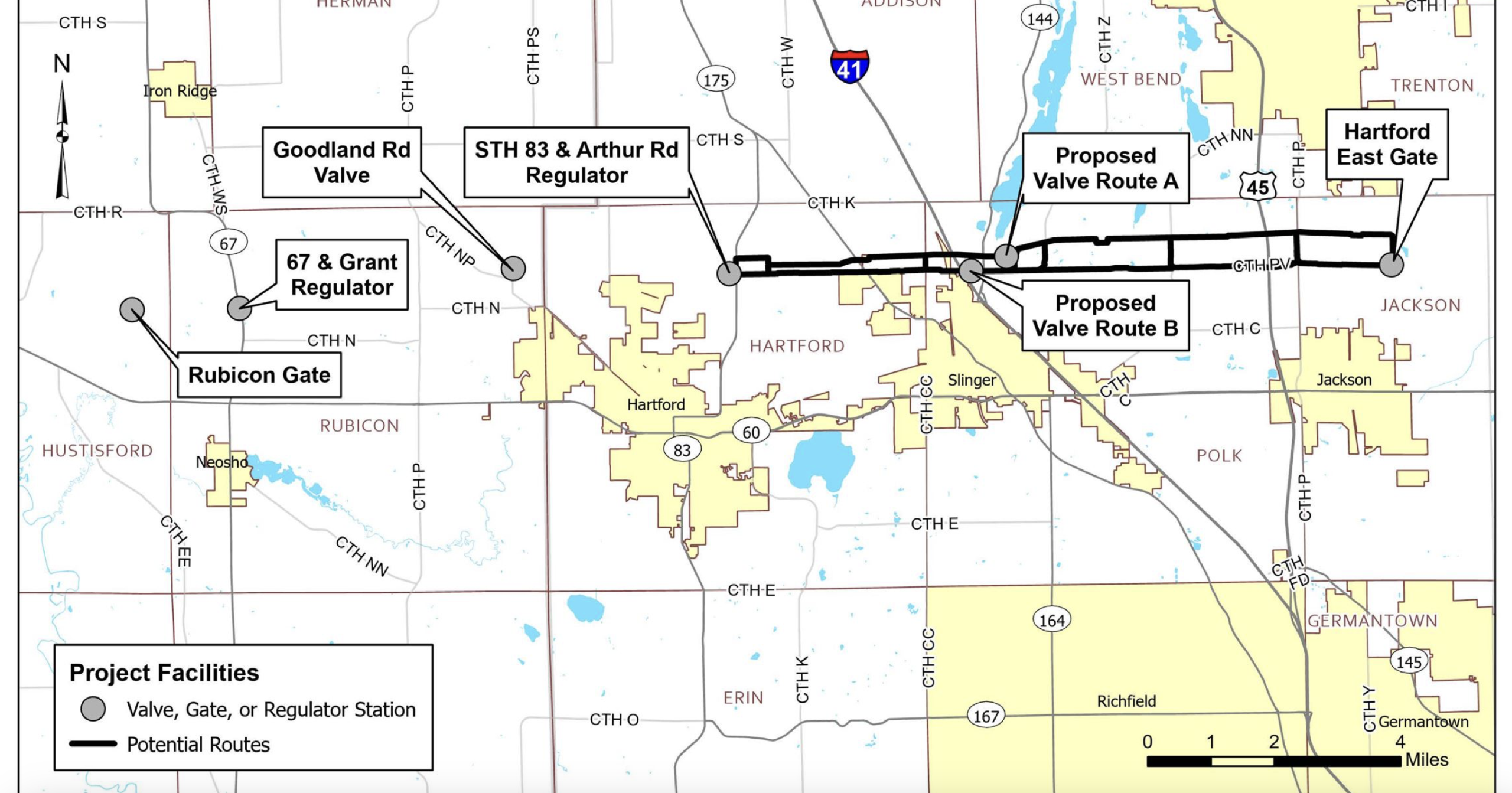
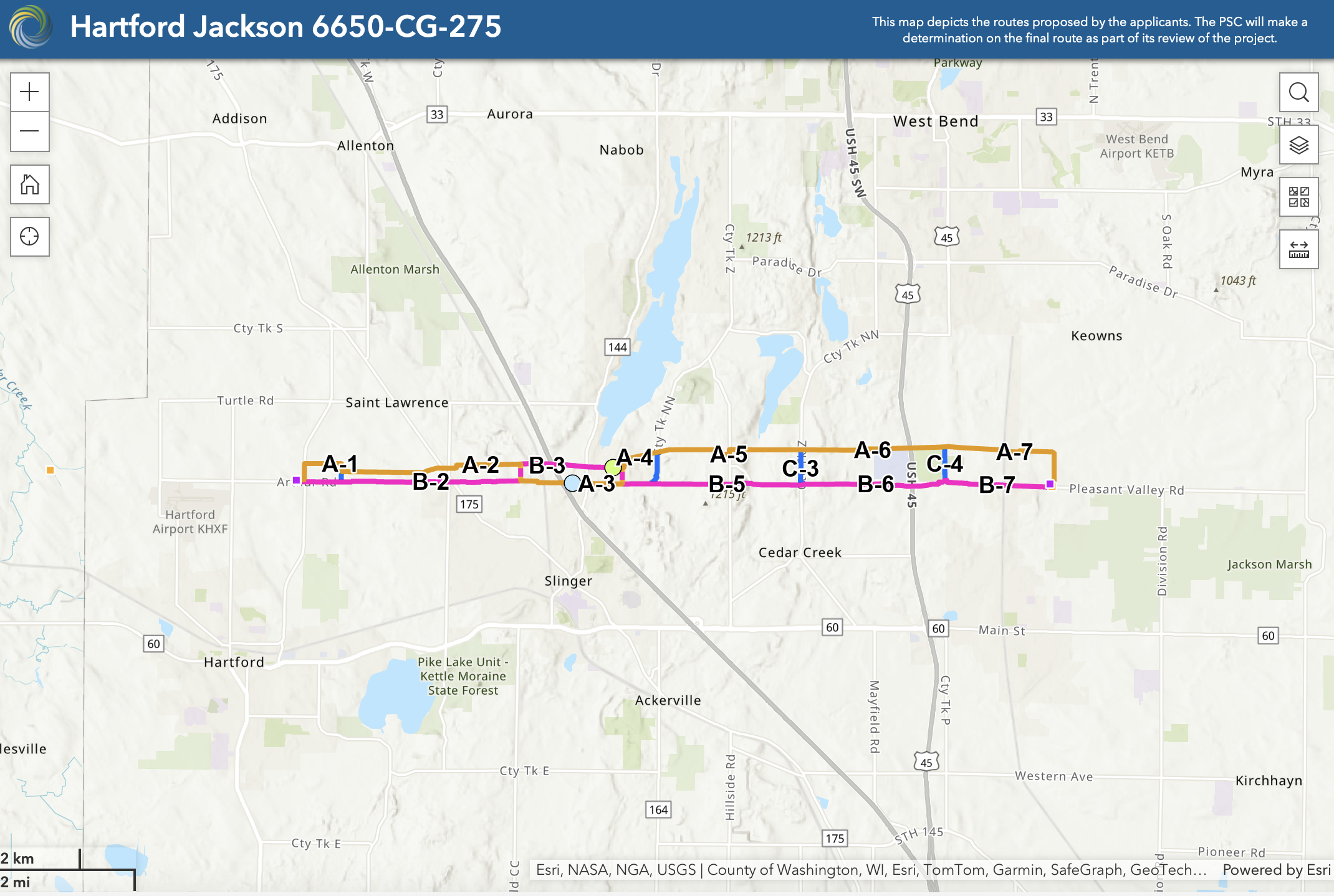
Click HERE for a detailed map
The majority of the land used for the project is agricultural. If approved, construction is planned to commence in spring 2026, with anticipated completion by fall 2027.

Wisconsin Gas states the purpose of this proposed project is to provide additional natural gas deliverability and reliability to the northern suburbs/lakeshore of Milwaukee, Wisconsin.
Below is notification sent communities impacted by the proposed project.

To the Recipient,
On December 2, 2024, Wisconsin Gas LLC (Wisconsin Gas or applicant), filed an application with the Public Service Commission (PSC or Commission) to receive a Certificate of Authority (CA) to construct and place in service a new 12-mile natural gas transmission pipeline and associated infrastructure in the towns of Hartford, Polk, and Jackson, and the village of Slinger in Washington County, and the towns of Rubicon and Hustisford in Dodge County, Wisconsin. This project has been designated as the “Hartford Jackson Interconnect Project.”
The proposed project would construct approximately 12 miles of 12-inch steel 850 pounds per square inch gauge (psig) maximum allowable operating pressure (MAOP) natural gas transmission main.
A component of this proposed project also includes a pressure increase of an existing high-pressure system from 400 psig MAOP to 850 psig MAOP, which requires upgrades to existing regulation and valving infrastructure.
Associated infrastructure would include installation of five valve assemblies, including one new valve assembly location; improvements to two existing gate stations (Rubicon Gate and Hartford East Gate), including an expanded footprint at Hartford East Gate; improvements to existing district regulator stations; and improvements to Goodland Road Valve Assembly.
This project would form a continuous 850 psig system from Rubicon Gate to Hartford East Gate Station to Port Washington Generating Station.

Two routes are proposed for this project; Route A and Route B. Route A would require approximately 57,809 feet of easement, 133 acres of right-of-way, and would cost approximately $40,620,187.
Route B would require about 31,665 feet of easement, 107 acres of right-of-way, and would cost approximately $42,158,539.
A third route, Route C, consists of segments that could be used to connect portions of Route A to Route B. The majority of the land used for the project is agricultural. If approved, construction is planned to commence in spring 2026, with anticipated completion by fall 2027.
Telephone: (608) 266-5481 Fax: (608) 266-3957 Home Page: https://psc.wi.gov E-mail: [email protected]


Docket 6650-CG-275
This is a Type II action under Wis. Admin. Code § PSC 4.10(2). It requires the preparation of an environmental assessment (EA) to determine if an environmental impact statement (EIS) is necessary under Wis. Stat. § 1.11. PSC and Wisconsin Department of Natural Resources (DNR) staff have completed a joint environmental review of the proposed project and prepared an environmental assessment (EA).
The EA is written following the guidelines in Wis. Admin. Code PSC 4.20 and is a review of the potential environmental effects of the proposed project that would affect the quality of the human environment as described in Wis. Stat. § 1.11(2)(c). The EA also describes ways of mitigating or avoiding some of the expected impacts and concludes with the evaluation of ten items described in Wis. Admin. Code § PSC 4.20(2)(d).
The preliminary determination indicates that no significant impacts on the human or natural environment are likely to occur because of the construction and operation of this project. Therefore, preparation of an EIS is not required. Comments regarding this determination can be directed to the contact person listed at the end of this letter.
The Commission is sending this letter to property owners near the proposed pipeline site or associated facilities, as well as individuals who have asked to be placed on our mailing list or have expressed interest in the project. This letter is also being sent to public officials in the project area. If you are a municipal clerk and receive this letter, please post it in a location where it can be viewed by the public.
The remainder of this letter describes the primary impacts of the project and summarizes the conclusions of the EA. To obtain a copy of the EA, please request a copy from the contact person listed at the end of this letter.
Construction
There would be temporary impacts during construction such as increased traffic, noise, and air pollution in the construction areas. Construction of the project would cause temporary increases in traffic in the project area because of workers, heavy equipment, and material deliveries using local roads.
Construction would also create loose or disturbed soils that could be susceptible to erosion and cause dust. Implementation of appropriate erosion control measures that are regularly monitored and remain in place until revegetation has occurred would minimize the potential for erosion and stormwater impacts.
Where the route would cross roads or driveways, there could be impacts to landowners or those driving in the area. Wisconsin Gas would provide affected landowners with advanced notice of when construction is anticipated to begin on their property and would repair driveways and roads to previous conditions after pipeline installation.
A large amount of the project would cross agricultural lands. Construction would cause temporary disturbances to agricultural operations. Once installed, these lands could immediately return to agricultural production, although the effects of pipeline installation can be seen for several years after construction due to soil disturbances, compaction, etc.
Wildlife and Natural Resources
The project would affect the animal and plant species that currently use the land. The applicant completed a Certified Endangered Resources (ER) Review with DNR to identify any protected species within the proposed project area. The ER Review for the proposed project recommended actions to help conserve Wisconsin’s endangered resources for one bee species, one bird species, two plant species, two herptile species and two resources categorized as “other.”
There is one bird species which requires actions to be taken to comply with state and/or federal endangered species laws. Wisconsin Gas states in its application that suitable habitat for the protected bird species was found to be present within the project area. The project would either avoid all disturbances to these areas during the active/breeding season or would have a qualified biologist conduct surveys to determine its presence/absence as stated in the Certified ER Review.
Based on this information as well as information available from the DNR and US Fish and Wildlife Service, the project as described in the application is not expected to have a significant impact on rare species.
Several waterways would be crossed during construction of this project. Construction methods used for crossing waterways include open cut trenching and horizontal directional drilling (HDD). There are no proposed permanent impacts to waterways associated with the project.
One risk associated with the HDD method is the potential for a spill, tunnel collapse, or rupture and release of drilling lubricant to the surface, known as a frac-out. The applicant provided a copy of its response plan for the inadvertent release of drilling lubricants during HDD activities which describes the actions to be taken should a frac-out occur.
Many wetlands would be intersected by this project. Some impacts to wetlands may be partially or wholly avoided by using HDD methods. The project would not result in any permanent fill in wetlands. All temporarily impacted wetlands would be restored to pre-existing conditions, except for shrub and forested wetland communities converted to herbaceous communities within the 20-foot-wide maintained right-of-way.
The project would impact approximately 8.4 acres of upland forest along Route A, 8.8 acres along Route B, and 0.96 acres along Route C. A 20-foot easement over the pipeline would be permanently cleared of trees for maintenance purposes.
There are no Forest Crop Law lands along the proposed routes. There are three properties enrolled in the Managed Forest Law (MFL) that would be intersected by or adjacent to the project area, however, there is no clearing of forested area proposed within MFL lands for this project.
Approximately 27.6 acres of grassland are located along Route A, 33.1 acres along Route B, and 12.4 acres along Route C. Staging areas contain 21 acres of grassland. Impacts to grassland are temporary in nature because vegetation would be allowed to regrow after construction.
Proposed Route A crosses about 81.2 acres of agricultural land, Route B crosses 42.5 acres, and Route C crosses three acres. Additionally, the staging areas contain 1.3 acres of agricultural land. Specialty agriculture, which includes a Christmas tree farm, covers 2.6 acres on Route A and 0.2 acres on Route B.
A total of nine parcels enrolled in the WDNR Farmland Preservation Program are intersected by the project totaling 26.6 acres. Four parcels contain drainage districts which would be intersected by Route A.
Wisconsin Gas developed an Agricultural Mitigation Plan which describes construction mitigation and restoration methods to be used on the project. The applicant stated that impacted agricultural land would be returned to original (pre-construction) conditions and would be able to be farmed as normal after the pipeline is installed. However, agricultural productivity may be impacted to some extent for years after project completion.
Archaeological and Historic Resources
A review of the Wisconsin Historic Preservation Database (WHPD) indicated that four Archaeological Site Inventory (ASI) properties and one cemetery are in the area of potential effect (APE). All four archaeological sites lacked the materials and integrity for listing on the National Register of Historic Places (NRHP) and the project would not impact the archaeological sites or cemetery. Therefore, no further investigations were required. Authorization from the Wisconsin Historical Society is necessary for any ground disturbance within the uncatalogued boundaries of the cemetery, which was obtained for the project.
The WHPD did not identify any previously surveyed Architecture History Inventory (AHI) resources within the project area. Additionally, the project would be constructed underground, therefore the project would not cause indirect visual effects to WHPD AHI properties. Based on these results, no historic properties would be affected by the proposed project.
Fossil fuels would be used during construction and the proposed project would contribute to emitting greenhouse gases during its operation.

Conclusion
Construction of the proposed project would result in short-term, localized increases in noise, vibrations, air quality degradation, as well as disturbance to local residents. Tree removal in upland forests could create a change from forested to open grassland or scrub habitat and, depending on the time of year, could impact sensitive species. Wetland impacts would be reduced through the use of directional drilling where feasible.
Community impacts would be primarily related to road and driveway impacts in the project area, as well as temporary, localized increases in noise, vibrations, air quality degradation, and odors.
The project as proposed in the application and subsequent filings, including use of the stated construction methods and implementation of the mitigation plans, is not expected to cause any significant or long-term environmental effects. No significant impacts on the human environment that would warrant the preparation of an EIS are expected. Thus, preparation of an EIS, as described in Wis. Stat. § 1.11, is not required for this project.
Copies of the EA are available upon request, either in electronic or paper format (for a paper copy, an address must be provided). Requests for a copy of the EA should be made to Emily Thompson at the Public Service Commission of Wisconsin by telephone at (608) 261-9408, by e-mail at [email protected], or by regular mail directed to the Public Service Commission, P.O. Box 7854, Madison, Wisconsin 53707-7854.
Click HERE to file a comment before September 5, 2025.
Comments on the finding of no significant impact for this proposed project should be made to Adam Ingwell at the address above or through the Commission’s web comment form. Go to the Commission’s website at https://psc.wi.gov , click on “Commission Actions,” then click on “File a Public Comment.” On the next page, select “File a comment” for case 6650-CG-275.
Please provide any comments by Friday, September 5, 2025.
Sincerely,
Adam Ingwell
Environmental Affairs Coordinator – Supervisor
Division of Digital Access, Consumer and Environmental Affairs