





September 23, 2026 – Washington Co., WI – The Wisconsin Department of Natural Resources (DNR) is continuing to monitor an outbreak of epizootic hemorrhagic disease (EHD) in southern Washington County, along with suspect reports in neighboring counties.
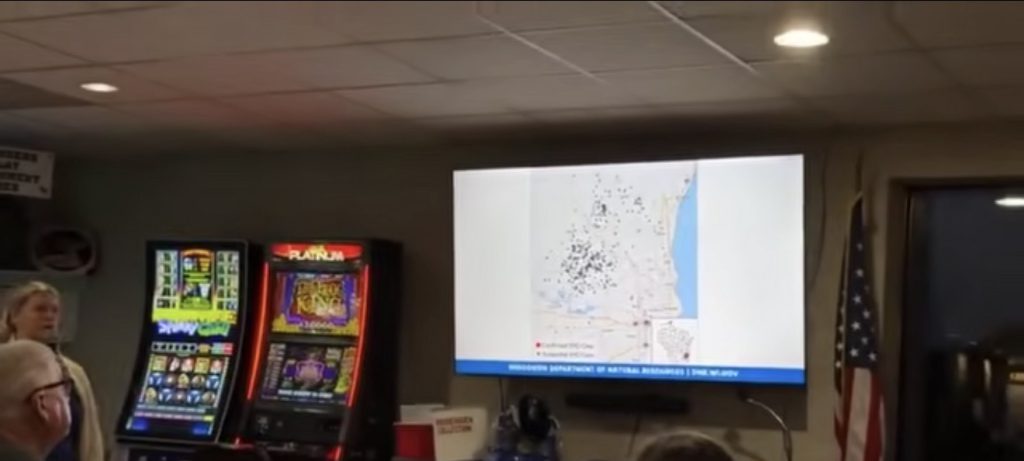
During a virtual media briefing this week, Erin Larson, DNR deer health specialist, provided an update on the state’s deer herd, EHD reports, chronic wasting disease (CWD), and the upcoming hunting season.

Larson said the 2026 deer season will proceed under current regulations, without reductions to harvest opportunities.
“Given the history of the deer harvest in that area and the current population size, the affected areas are still likely able to support an ample harvest this fall,” Larson said.
She acknowledged, localized areas may experience high mortality rates from EHD but said the disease’s impacts are generally short-lived and deer populations can rebound.
“Continuing to harvest deer is one of the best ways that we can help to keep our deer population healthy,” Larson said.
The following questions and answers focus on the discussion between media and Larson.
Media Questions and DNR Responses
CWD dumpsters: How many fewer dumpsters will be available this year?
Question: Danielle Kaeding asked about the reduction in deer carcass waste dumpsters, including how many fewer dumpsters would be available due to staffing and resource constraints.
Erin Larson:
“Due to rising operational costs and budgets overall, and decreasing revenue, you know, some of those, uh, will impact CWD operations, and one of those being the dumpster availability.”
“The final decisions are still being worked through on which dumpsters will be removed. We are still making sure to have options statewide. So, there won’t be an area that doesn’t have any options, but it just may be that, you know, a county that maybe had a couple of dumpsters will now only have one.”
Larson said dumpster locations would be added to the DNR’s interactive map as they are placed later in October.
CWD: Have there been new detections this year?
Question: Kaeding asked whether new CWD detections had been found outside the areas identified last year, including Clark and La Crosse counties, and what the detections mean for hunters’ health.
Erin Larson:
“There haven’t been any other, you know, newer areas since last fall that have had a detection of chronic wasting disease.”
Larson encouraged hunters to use the DNR’s cumulative CWD map and interactive map to locate positive detections and measure the distance from hunting properties or cabins.
EHD: Is venison from an affected deer safe to eat?
Question: Judy Steffes asked whether deer affected by EHD are safe for people to eat, a question raised by hunters and residents in Washington County.
Erin Larson:
“EHD is caused by a virus. That virus is not, humans aren’t able to get that, that virus whether from consuming venison from a deer that was exposed or even from the carcass. So, yes, it is safe for humans to consume.”
Follow-up question: Steffes noted that hunters and landowners had reported scavengers were not consuming some of the dead deer and asked how the DNR could determine the meat was safe.
Erin Larson:
“The virus itself does not last long in a carcass either.”
Larson explained that EHD can cause internal hemorrhaging and fluid buildup in a deer’s lungs and heart sac. She said she did not know whether those conditions affected scavengers’ decisions to consume the carcasses and would need to follow up on that question.
“But the EHD virus is not a risk to humans,” Larson said.
EHD reports: How accurate are the numbers, and how can the DNR predict a rebound?
Question: Steffes questioned the accuracy of reported deer deaths after the number of Washington County reports increased from approximately 1,000 to more than 1,100. She noted the figures did not include deer that had died but were not reported and asked how the DNR could predict a quick population rebound.
Erin Larson:
“The numbers we are sharing on our website are the reported submissions that we’re getting.”
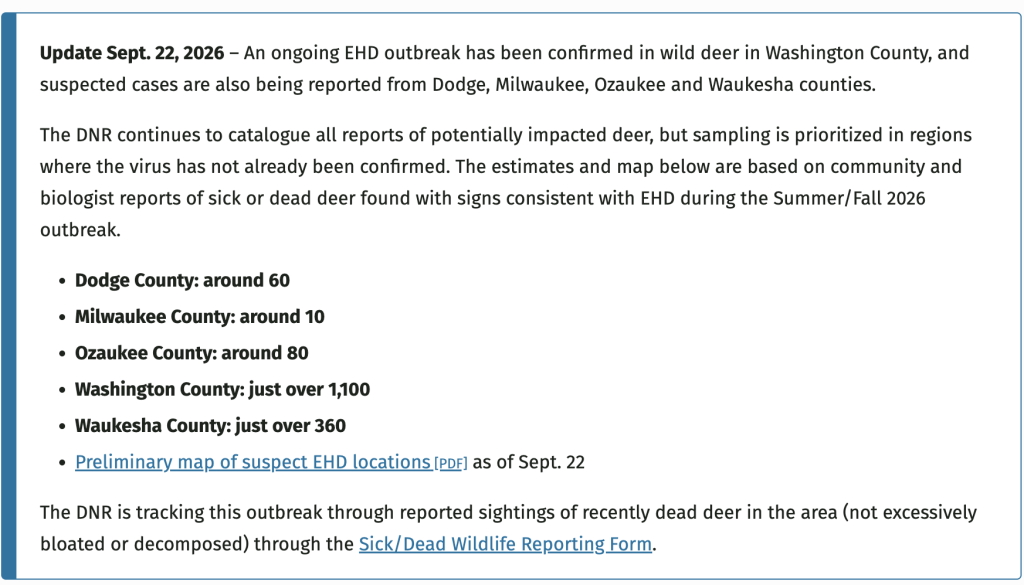
Larson said DNR wildlife staff were working in the area but did not have access to all private property. The department relies on reports submitted by citizens and landowners.
“They are being sent every day and so we are, you know, very much in the middle of cataloguing all of these reports reviewing them.”
She said additional work would be needed to clean up and review the data, including factors such as reporting rates and the amount of private land accessible to those making reports.
“So again, it’s what we can report is what we’ve been made aware of.”
EHD prevention: Can ivermectin, standing water cleanup, or other measures help?
Question: Steffes asked whether ivermectin or other preventive measures could help reduce the spread of EHD. She also asked about removing standing water or cleaning up puddles on private property.
Erin Larson:
“There’s really no scientific backing for that for EHD.”
Larson said there is no scientifically supported mechanism currently shown to prevent the outbreak through those measures.
She explained, the biting midges associated with EHD prefer moist soil or substrate during part of their life cycle, not just standing water.
“So it would really be impossible to remove all of the habitat that the midges use, nor would we recommend doing something like that as it could have much more widespread impacts to the ecosystem as a whole.”
Click HERE for more information on EHD from the Wisconsin DNR

DNR response: Is the EHD outbreak a concern for the department?
Question: Steffes asked whether the high number of reported dead deer in Washington County was concerning to the DNR, particularly given the alarm among farmers, landowners, and hunters.
Erin Larson:
“I want to make it clear that we are always concerned on the deer herd statewide.”
Larson said the DNR collects reports of unusual or abnormal wildlife conditions throughout the year, not just during the current EHD outbreak.
“We’re asking, hunters and citizens, if you’re finding something that’s not normal or seeing something, please send us that and we catalog those reports year round.”
She said the department is monitoring EHD statewide and will seek samples from other areas when possible to determine whether suspect reports are consistent with the disease.
“So it’s something that we take seriously and that we are monitoring for.”
EHD spread: Is the disease moving into neighboring counties?
Question: A media representative asked whether the DNR was concerned about EHD spreading from Washington County into nearby counties.
Erin Larson:
“Yeah, we’re certainly watching that a lot.”
Larson said suspect reports had been received from five counties. The majority of reports were within approximately 20 miles of confirmed diagnostic testing sites in the Richfield and West Bend areas of Washington County.
“If we are getting much further away from that, that’s another reason we would try to collect another sample and see if it is spreading.”
She said the majority of suspect reports continued to come from the Richfield area, where the DNR was receiving a significant number of reports.

EHD outbreak: What has caused the high number of reports this year?
Question: A media representative asked what had made 2026 such a significant year for EHD reports and deer mortality.
Erin Larson:
“There’s a lot about EHD that is still unknown, you know, and still being researched and looked into.”
Larson said researchers were examining the factors that contribute to when and where outbreaks occur. Environmental conditions, including drought and temperature, may play a role.
“But that certainly doesn’t mean that everywhere there’s a drought, there’s going to be an EHD outbreak.”
She said much remains unknown about the drivers of EHD outbreaks.
CWD testing: How many samples does the DNR expect to collect this year?
Question: A media representative asked how many CWD samples the DNR expected to collect statewide in 2026.
Erin Larson:
“Last year, you know, we’re over 18,000, I believe, samples. So we expect that we’ll get potentially around 17,000 this year.”
EHD tracking: Is the DNR documenting the date and location of reports?
Question: Steffes asked whether the DNR was tracking the dates and locations of reported deer deaths to identify a possible epicenter of the outbreak.
Erin Larson:
“All of the reports that we get, we have a comprehensive database that we can put in these reports where we can, all of the metadata that goes along with it.”
Larson said the database includes the date a report was submitted and its location. The DNR also adds latitude and longitude information when available.
“All of the data associated with these reports is captured and cataloged.”
She said the information is used to create the EHD map available on the DNR’s website.
EHD prevention: Is the DNR working on ways to stop future outbreaks?
Question: Steffes asked what proactive steps the DNR was taking to stop the outbreak or prevent a significant reduction in the deer herd in the future. She referenced concerns among Washington County hunters and landowners and outbreaks in other states.
Response: The question was not answered during the briefing. The moderator offered to arrange a longer-form interview with Larson following the media briefing and encouraged Steffes to contact the DNR press office.
CWD funding: Are the dumpster reductions connected to the state’s fish and wildlife funding shortfall?
Question: Kaeding returned to the issue of CWD operations and asked whether the reduced dumpster availability was tied to the state’s fish and wildlife account and funding shortfall.
Erin Larson:
“With the information that’s been shared out on the overall budget situations with the DNR and the situation that the department is in and needing to make some cutbacks in some areas, this is all related as well.”
The DNR said updated EHD reports and maps are available on its website. The reported numbers represent submissions received by the department and are not an estimate of the total number of deer affected by the disease.
On a side note:
-The nine day gun-deer season is November 21 – 29.
-Representatvies from the DNR attended the Citizens Deer Advisory Council in West Bend, WI on September 21, 2026. Click HERE for a report from that meeting.