





September 2, 2026 – Washington Co., Wi – The Washington County Public Safety Committee meets at 4 p.m. Wednesday, September 2, 2026 and according to the agenda the committee will vote on a resolution authorizing the creation of a countywide EMS system.
Click arrow in lower-left corner to advance the page
Calls were placed to several county supervisors including Doug Neumann, who sits on the Public Safety Committee. He said more numbers would be released today.
Elected officials, the owner of Lifestar Emergency Medical Service, and taxpayers from municipalities in Washington County, WI, are weighing in with concerns on the resolution prior to Wednesday’s meeting.
Scott Hefle is a trustee on the Germantown Village Board.

Paul Zimdars is a Trustee in the Village of Newburg and he makes clear his questions are made as his own person and he is not speaking for the entire Village Board.


August 21, 2026 – Village of Slinger, WI – The Slinger Village Board met with Washington County Board Supervisor Jeremiah Moll this week to try and obtain more detailed information regarding the new EMS countywide tax currently being considered.
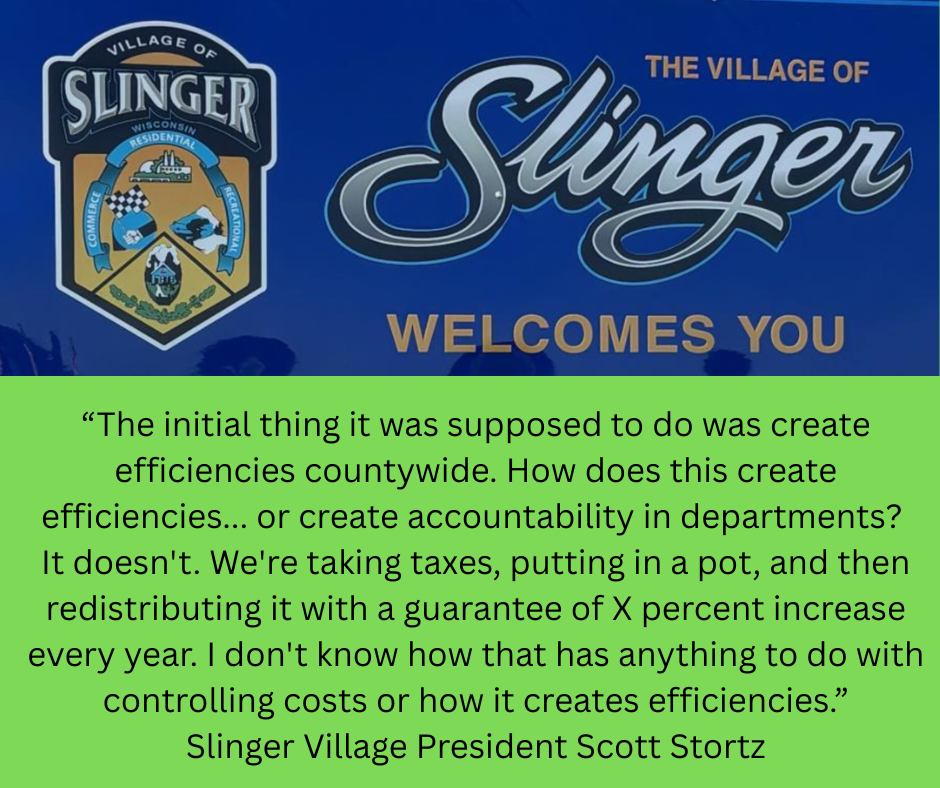
According to Village President Scott Stortz, “Upon completion of this meeting, it was clear to the board this initiative is far from being ready for implementation. With that, the board decided to rescind their previous resolution of support and sent the attached letter of explanation to County Executive Josh Schoemann and members of the County Board.”
Click arrow in lower left corner to advance to Page 2
The Slinger Village Board rescinded its previous resolution supporting a proposed Washington County EMS tax, saying the program remains too undefined to justify moving toward implementation.
Stortz said Slinger’s original resolution was intended to keep the village involved in discussions about a potential countywide EMS system—not to provide blanket support for creating a new tax.
“The way it was explained to us is we need to collectively, as municipalities, say that there could be some potential value to continue the discussion,” Stortz said. “All seemed reasonable to us. Yes, let’s be proactive rather than reactive.”
He said the situation changed as the county moves toward a potential November vote.
“Right now, I feel it’s being fast tracked.”
Below is 11 pages from the county’s Public Safety Committee meeting on Wednesday, August 19, 2026. Countywide EMS is item No. 3 (c) for discussion. As of Wednesday morning, no information on the item was included in the packet.
Click arrow in the lower left corner to advance the page.
Stortz said the village’s concerns center on the lack of detailed guidelines, cost controls, accountability and oversight. He questioned how the proposed system would create efficiencies or prevent rising costs when those mechanisms have not been clearly presented.
“The whole original point was this was going to be a way to potentially consolidate services, and this grandiose plan was going to afford us the opportunity to share services and bring down costs, and none of that has been discussed,” Stortz said. “None of that has been put on paper.”
He added, “Where is the accountability? You can’t give every department everything they want, and not raise your taxes. We just feel there has to be more in-depth discussion and planning before the county board goes ahead and starts another tax.”
A particular concern for Stortz is whether municipalities would have meaningful oversight over how the money is spent and whether the proposed structure would actually control costs.
“This was originally, quote unquote, sold to us as a countywide system that would help control costs. It would create efficiencies within the EMS and fire system,” Stortz said. “We haven’t seen anything.”
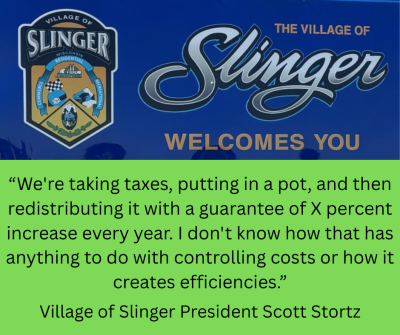
“We’re taking taxes, putting it in a pot, and then redistributing it with a guarantee of X percent increase every year. I don’t know how that has anything to do with controlling costs or how it creates efficiencies.”
Stortz also questioned whether Slinger needs to participate in the proposed program at all.
“For the Village of Slinger, frankly, we don’t have a problem,” he said. “We are blessed with a phenomenal fire department that has very tight controls on their spending and they’re financially more than solvent. They’re 100% volunteer.”
Slinger also has a $0 contract with its EMS provider, LifeStar Ambulance, according to Stortz.
“We are extremely fortunate to have a phenomenal EMS service that does not charge the municipality for those services. That’s zero cost to my taxpayers,” he said.
Because of that arrangement, Stortz questioned why Slinger residents would be taxed for a service the village currently receives without a municipal contract expense.
“Right now, if Slinger has a $0 contract, which we do, and now the county is going to levy us X dollars, okay, for EMS, what are we supposed to do with it?” Stortz said. “Now we’re almost being forced to spend money on a service that we’re getting for free. Right. So that just doesn’t make sense to me.”

Stortz also questioned the county’s decision-making process, particularly the push toward a November implementation despite what he described as significant unanswered questions.
“My question to Jeremiah was, if you guys don’t have the answers to these questions, then you should not be voting yes on this proposal,” said Stortz noting, “the county should be willing to delay a vote rather than move forward simply because a considerable amount of work has already been done.”
“For the county executive and the county board to say, you know what? We’re not ready. That’s okay. That doesn’t mean you failed,” Stortz said. “That means that you’re acknowledging that it’s not quite completely vetted and ready to go. So let’s tap on the brakes here.”
Stortz said the absence of clearly defined rules and safeguards also raises concerns about the long-term future of the tax.
“If we start this program without true guidelines and without a true path, without true rules of engagement and a list of expectations that must be met in order for it to move—well, if we don’t have those in place, then this tax will potentially never go away,” he said, pointing to the county’s former stadium tax as an example.
“The minute a program is started and a tax is enacted, it is there. It’s there forever. It’s never going to go away.”
Stortz emphasized that his objections are not directed at county officials, fire departments or EMS providers.
“This is not an anti-Josh thing,” he said. “It’s not that we don’t appreciate Josh being proactive in talking about this and planning for the future. We do… We just don’t feel it’s necessary to pass it right now when there’s just too much left unsaid.”

He also said the village is not opposed to continuing to research the possibility of a countywide solution if circumstances change.
Possibly, someday, there might be a need for more of a countywide solution as costs continue to skyrocket,” Stortz said. “But that doesn’t necessarily mean the county needs it right now.”
The proposed tax, he argued, should not be advanced until the county can demonstrate what problem it is solving, how the money will be used, and what accountability will exist once the program is established.
“My board is fully in favor of continuing to research, discuss, plan, develop,” Stortz said. “What we’re not in favor of is pushing this through right now based on the very limited information we have. And, frankly, the non-existent guidelines.”
Stortz said the village’s decision to rescind its earlier resolution was intended to make sure county supervisors understood that Slinger’s original support was conditional.
“These resolutions are being used as a quick CLIFFNOTES version to ‘yes.’ And that’s really not what they were meant to be,” he said. “They were basically meant to be to say, okay, we’re continuing to go down this path so we have a seat at the table.”
As the county considers whether to proceed, Stortz said Slinger wants the county board to slow the process down and complete its due diligence.
“My board felt it was time to send a clear message to the county board that you guys owe the taxpayers due diligence,” Stortz said. “Do your homework. Make sure it’s fiscally responsible. Make sure this is the plan you want in place, probably forever, before you go ahead and vote on this.”
Stortz said the village’s position ultimately comes down to timing and preparation.
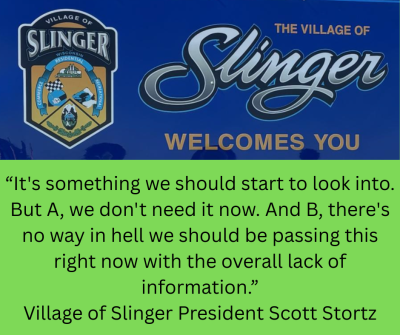
“We may have a problem someday, and it’s something we should start to look into,” he said. “But A, we don’t need it now. And B, there’s no way in hell we should be passing this right now with the overall lack of information.”
“We wanted to send a clear message to the entire county board: please pump the brakes, make sure all your ducks are in a row, and all of your questions are answered, and this plan is, in effect, going to help consolidate services, and control costs before you enact another tax.”
Calls were placed to supervisor Moll, who will eventually be voting on the proposal. He said he would review the Village board’s email and have a comment on Friday, August 21, 2026.
County Board chairman Jeff Schleif, who will also be voting on the proposal was also contacted, for the seventh time. He attended the Wednesday 7 a.m. Public Safety Committee meeting. A message was left and this story will be updated when his comments are available.
On a side note:
- Former County Supervisor Lois Krueger Gundrum said, “This is how the county board has operated under the executive form of government. County Executive Schoemann starts with a push for approval of a concept idea approved by the Executive Committee, and then followed by a final approval by the entire County board with no details.”
- It has been confirmed, LifeStar Emergency Medical Services, has not been invited to the discussions regarding EMS service in Washington County, WI. However, various leaders in local municipalities have reached out to LifeStar owner Mike Krueger regarding EMS service.
- On Monday the Village of Germantown Board also voted 8-1 to table a resolution conditionally supporting participation in the Washington Countywide EMS system. “I think this board is sorely opposed to signing a resolution no matter what attorney Sajdak has to say, honestly,” said trustee Jolene Pieper. The single vote to approve the resolution was cast by Village President Bob Soderberg.
- Other municipalities which have gone on record questioning the EMS proposal include the Town of West Bend, Town of Polk, Village of Newburg, and Town of Trenton.
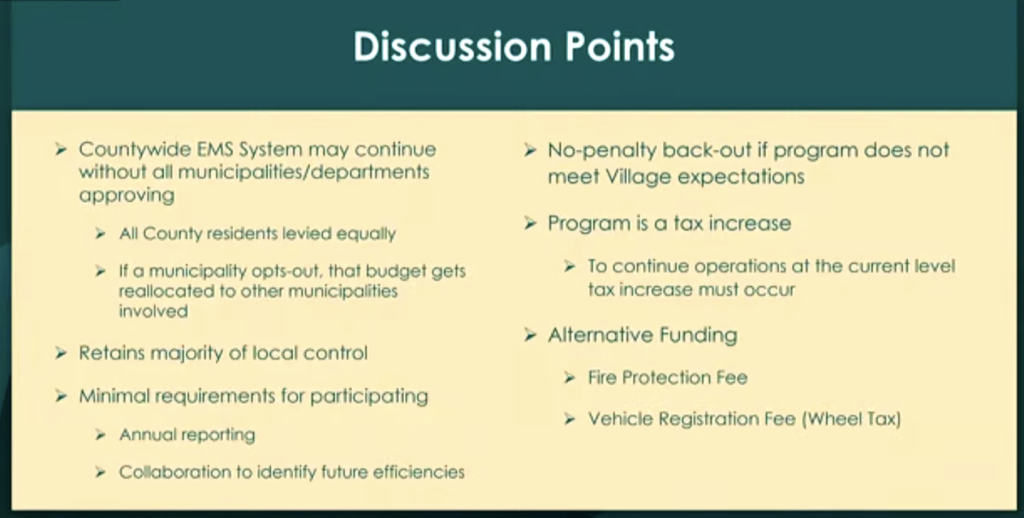
- Municipalities have questioned: “If a municipality opts-out, that budget gets reallocated to other municipalities involved.” The discussion point was questioned: “No-penalty back-out if program does not meet Village expectations.” So far, no county official has been able to answer exactly what that means.
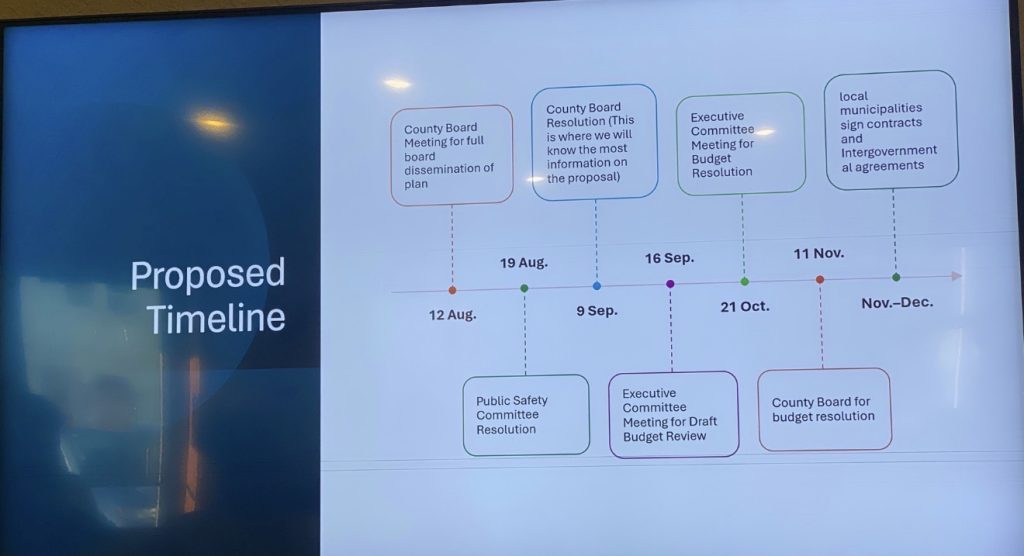
On the ‘Proposed timeline’ the county board will vote on the EMS resolution in November and after the vote “local municipalities sign contracts and intergovernmental agreements.”
-
The county Public Safety Committee met Wednesday. County supervisor Doug Neumann led the discussion on the mechanics of the proposed EMS plan which included the length of the agreement, the percentage of increases year-over-year, the county administrative fee, and smart goals.This is a working story and more information will be posted when details are available.