



May 7, 2026 – Washington Co., WI – Wisconsin families deserve an honest conversation about energy policy. Every month, ratepayers are told their utility bills must increase because the grid needs upgrades, new generation is needed, and the state must transition toward cleaner energy sources.

Some of that is true. Reliable electricity is essential to modern life, economic growth, public safety, and national security. But if we are serious about affordability, reliability, and achieving long-term carbon reduction goals, we also need to be honest
about the limitations and costs of the current path we are on.
At the Public Service Commission of Wisconsin open meeting on May 7, commissioners reviewed another round of utility infrastructure proposals, including substations, transmission projects, and large-scale energy developments. Just weeks earlier, WEC Energy Group, the parent company of We Energies and Wisconsin Public Service, filed a major rate increase request for 2027 and 2028 that could raise residential electric bills by roughly 14 percent over two years.
As Megan Novak recently noted in The Heartland Post, Wisconsin ratepayers have now seen more than $2.2 billion in approved utility rate increases since 2019. Whether one agrees with every political argument surrounding those increases or not, the underlying concern is real: Wisconsin families are paying more and more for energy while being told there is no alternative.
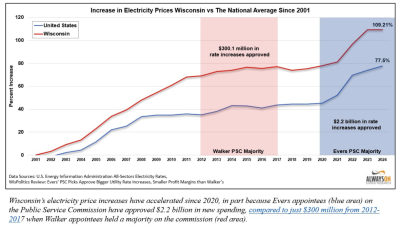
Data from the U.S. Energy Information Administration further illustrates the trend.
Electricity prices in Wisconsin have steadily risen faster than the national average since the early 2000s. According to the graph compiled using EIA all-sector electricity rate data, the period from roughly 2012 through 2017 saw approximately $300 million in approved rate increases while PSC commissioners appointed under Governor Walker held a majority on the commission.
Since 2020, however, approved utility spending and rate increases have accelerated dramatically, with PSC commissioners appointed under Governor Evers approving more than $2.2 billion in new utility spending and associated rate impacts. While multiple factors contribute to rising energy costs, including inflation and infrastructure needs, the scale and pace of approved spending matters to every Wisconsin ratepayer.
Most Wisconsinites understandably assume utility companies make money by selling electricity. In reality, regulated utilities primarily earn profits based on how much infrastructure they build and own.
Under Wisconsin’s utility regulatory model, companies are granted a guaranteed Return on Equity, or ROE, on approved capital investments. In simple terms, the more infrastructure that gets approved and added to the utility’s “rate base,” the more profit the utility earns from ratepayers over time. Utilities do not maximize profits by producing electricity efficiently. They maximize profits by constructing and financing more infrastructure.
That creates what energy economists often call a “capital bias.” The system naturally incentivizes continuous expansion: new substations, new transmission lines, renewable generation facilities, battery storage systems, and grid modernization projects.
Some investments are necessary. But ratepayers should recognize that the financial incentives embedded in the system encourage building more infrastructure because infrastructure generates guaranteed returns.
Novak summarized the issue bluntly in her article:
“The more they build… the more opportunity they have to recover costs from ratepayers while earning a return.”
That observation gets to the heart of the debate Wisconsin should be having right now. At the same time, Wisconsin families are still paying for stranded assets from the past.
Across the Midwest, utilities retired coal plants before the end of their financial life. Even after those facilities stopped producing electricity, ratepayers continued paying off the remaining balances through utility bills. In many cases, customers are now simultaneously paying for retired infrastructure and the replacement infrastructure being built to replace it.
Novak accurately described this as “paying for yesterday’s system and tomorrow’s system at the same time.”
Utilities argue that this framework is necessary because the investments were prudently approved when originally constructed. Regulators have generally agreed, reasoning that utilities must be able to recover investments in order to attract financing for future projects. Legally and financially, that explanation makes sense. But from the perspective of a Wisconsin family opening another expensive utility bill, the result feels increasingly disconnected from reality.
Now Wisconsin is moving aggressively toward greater dependence on intermittent generation sources, meaning primarily wind and solar power. Wind and solar absolutely have a role in the energy mix. But policymakers should stop pretending they operate like traditional baseload generation.
Unlike nuclear, coal, or natural gas facilities, wind and solar generation fluctuate based on weather conditions and time of day. Solar panels produce no electricity at night and far less during Wisconsin winters, cloudy periods, or snow coverage. Wind generation can vary dramatically depending on weather patterns and seasonal conditions.
Because of this intermittency, the grid still requires reliable backup generation and expanded transmission infrastructure to maintain system stability.
Wisconsin’s geography presents additional challenges for large-scale solar deployment. Arizona utility-scale solar facilities have achieved capacity factors approaching 29 percent, among the best in the country. Wisconsin solar facilities often operate far lower, commonly in the high teens to low twenties depending on location and season.
In practical terms, that means Wisconsin must build significantly more solar infrastructure to generate the same amount of electricity produced in sunnier regions of the country.
That lower efficiency has real consequences for land use and infrastructure scale. A typical nuclear facility generating roughly 1,000 megawatts of electricity can operate on approximately one to two square miles while running at capacity factors around 90 percent.
By comparison, producing equivalent annual output through solar generation can require dozens of square miles of panels and supporting infrastructure. Some analysts estimate solar requires roughly 75 times more land area than nuclear to generate
comparable output, while wind requires even more.
Those land-use impacts are not theoretical. Large solar developments often convert thousands of acres of farmland or open space into industrial energy sites. Wind facilities require expansive turbine arrays spread across rural communities. Additional
transmission corridors must then be constructed to move intermittent energy across the grid.
There are also long-term replacement and environmental considerations that deserve more public attention. Modern nuclear plants are increasingly licensed to operate for 60 to 80 years. By comparison, utility-scale solar panels, battery systems, and wind turbines often require major replacement or repowering within roughly 20 to 30 years. That means the transition to renewable infrastructure is not a one-time buildout. It creates continuous cycles of replacement, disposal, manufacturing demand, and infrastructure renewal over future decades.
Battery storage systems introduce additional concerns involving fire risks, chemical leakage, mining demands for rare earth materials, and disposal challenges. Solar and wind infrastructure are also vulnerable to hail damage, tornadoes, ice accumulation, and storm-related degradation. None of these challenges are insurmountable, but they should be discussed honestly rather than ignored for political convenience.
If Wisconsin sincerely wants to pursue net-zero carbon goals while maintaining reliability and affordability, then advanced nuclear energy must be part of the conversation. Modern nuclear technology offers reliable carbon-free baseload generation
operating 24 hours a day regardless of weather conditions. It minimizes land use, reduces the need for massive backup generation systems, and provides stable long-term output over generations rather than decades. Yet federal permitting delays, outdated regulations, political opposition, and financing barriers continue slowing deployment of next- generation nuclear technologies.
At the same time, Wisconsin should support policies that allow large energy users, including data centers and industrial facilities, to develop more on-site generation capacity. Allowing major consumers to produce a portion of their own power through cogeneration, microgrids, or future small modular reactor technologies could reduce stress on the broader grid and lessen the need for endless utility-funded infrastructure expansion passed onto residential ratepayers.
Wisconsin needs reliable power. We need affordable power. And if we are serious about reducing emissions, we need policies grounded in engineering and economic reality rather than slogans.
Ratepayers deserve transparency about how utility profits are generated, how stranded assets continue affecting bills, and how different energy sources actually perform in real- world conditions. The conversation about our energy future should not be driven by ideology. It should be driven by reliability, affordability, environmental stewardship, and honesty with the people paying the bills.
Rep. Dan Knodl – 24th Assembly Representative
WCI COMMENTING RULES OF ETIQUETTE:
While open and honest debate is encouraged here, Washington County Insider asks that you comply with the following rules for posting. Those who do not comply will have their posts removed which may result in being banned from commenting.
Washington County Insider will not publish comments that:
Are considered likely to provoke, attack, or offend others. This is known as “trolling.” Trollers know when they are trolling, and so do we. *See definition of “troll” below. If you notice a few consistent blog trolls disappear, you’ll know why.
Are sexually explicit, abusive, or otherwise objectionable.
Contains inappropriate or vulgar language that is likely to offend.
Break the law or condone or encourage unlawful activity. This includes breach of copyright, defamation, and contempt of court.
Advertise products or services for profit.
Are seen to impersonate someone else.
Repeatedly post the same or similar messages (‘spam’)
Include personal contact details such as telephone numbers and postal or email addresses.
Include a link or photo that has not been approved by the editor prior to posting.
Are considered campaigning. See also “trolling” above.
Are unrelated to the topic.
NOTES:
Just because your comment doesn’t show up right away doesn’t mean you’re being censored. When you post a comment, it must first go through our filtering software. If it fails, your comment goes into a queue for manual approval.
Just because a comment or advertisement is on the site, doesn’t mean WCI endorses it.
The above rules are not intended to stop criticism or dissenters, but rather to stop those who are incapable of participating in a civilized manner.
*Trolling: a troll is a person who sows discord on the Internet by starting arguments or upsetting people, by posting inflammatory,[1] extraneous, or off-topic messages in an online community (such as a newsgroup, forum, chat room, or blog) with the intent of provoking readers into an emotional response[2] or of otherwise disrupting normal, on-topic discussion,[3] often for the troll’s amusement. (source: Wikipedia)
All letters must include a US Postal address and direct cell/phone number for record keeping.